Giroux Daguerreotype Camera
1839 · Daguerreotype · Work 236 of 1,871
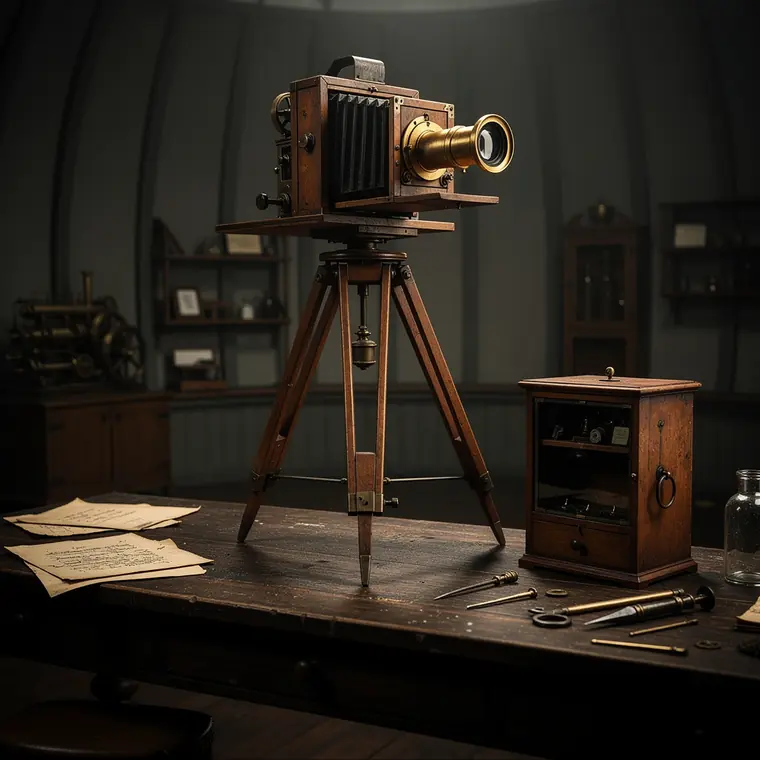
A Giroux daguerreotype camera on its tripod in a Paris studio, sliding box body with a brass barrel lens, iodine sensitising box and mercury developing cabinet beside it.
- What it was used for
- Buyers used the apparatus to make one-off images on silvered copper plates by Daguerre's process. On 22 June 1839 Daguerre and Isidore Niépce contracted with the Paris dealer Alphonse Giroux, a relative of Daguerre's wife, giving him the right to sell the materials and equipment (George Eastman Museum). The first advertisement appeared on 21 August 1839, two days after Arago's address to the Academy; the first shipment reached Berlin on 6 September. The outfit cost 400 francs, which New Atlas puts at roughly the annual income of an average working man. Daguerre recommended exposures of 3 to 30 minutes depending on the light. The example at the George Eastman Museum bears Daguerre's signature and Giroux's red wax seal; another sold at WestLicht in Vienna on 29 May 2010 for 732,000 euros including premium.
- What was new
- The camera itself, a wooden outer box with an inner box and an achromatic lens, was optically nothing new. What was new was that a just-published photographic process could be bought as a ready-made device instead of being built by the user; the George Eastman Museum calls it photography's first camera manufactured in quantity. Giroux was not alone: Susse Frères also sold a nearly identical camera in 1839, and sources differ on whether Giroux's right was exclusive. Talbot had already presented his paper process to the Royal Society in January and February 1839. The barb: France bought the process for life pensions (4,000 francs a year for Isidore Niépce, 6,000 in total for Daguerre) and gave it free. In England, however, Daguerre's agent Miles Berry held the exclusive right to the process from 14 August 1839 to 23 June 1841.
Further reading
- George Eastman Museum: Daguerre Introduced Photography 175 Years Ago
- George Eastman Museum Collection: Giroux daguerreotype camera, 1978.1631.0001
- Science Museum Group Collection: Alphonse Giroux
- New Atlas: World's oldest and most expensive camera to go under the hammer (2010)
- The Register: Daguerreotype auction (29 January 2010)
- Leica Rumors: WestLicht Photographica Auction results (31 May 2010)
- Maison Nicéphore Niépce: Isidore Niépce and Daguerre
- Oxford Art Journal 36/3: 'Beard Patentee': Daguerreotype Property and Authorship (Abstract)
- The Metropolitan Museum of Art: William Henry Fox Talbot and the Invention of Photography
- Hati and Skoll Gallery: The earliest daguerreotype cameras
- Science Museum Group: Richard Beard (Daguerre and his agent Miles Berry)