Palo Alto Motion Study
1878 · Motion Study · Work 237 of 1,871
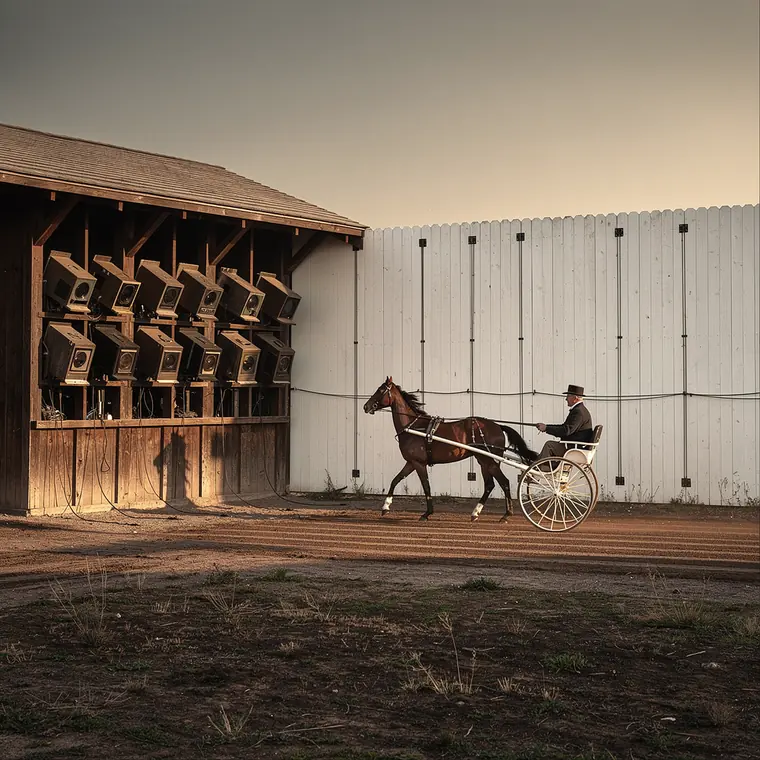
Muybridge's battery of twelve cameras ranged along the Palo Alto track: a long low timber shed open toward the course, twelve box cameras side by side inside it with their lenses in a row facing the track, opposite them a wall of white planks marked with vertical lines, trip wires stretched across the course at ground level and struck by the sulky wheel, a trotting horse harnessed to a light two-wheeled sulky with its driver mid stride before the white wall.
- What it was used for
- Leland Stanford, railroad magnate and breeder of trotters, had Muybridge photograph the gaits of his horses at his Palo Alto Stock Farm. The question was whether a horse at speed lifts all four legs off the ground at some moment. On 15 June 1878 invited journalists and sportsmen watched twelve cameras photograph the trotter Abe Edgington in less than half a second; the plates were developed on the spot. The published card of the galloping mare Sallie Gardner is dated 19 June 1878. Muybridge issued the series in 1878 as photographic cards titled The Horse in Motion; in 1879 he enlarged the setup to 24 cameras. According to Stanford Magazine, virtually every serious historian who has examined the supposed 25,000-dollar wager by Stanford has concluded there was no bet.
- What was new
- What was new was that the subject triggered the cameras itself: for the trotter a sulky wheel rolled over wires laid across the track, for the gallop the horse broke stretched threads, and each contact released an electromagnet that snapped the shutter of its own camera. This produced series at intervals of about 1/25 second; Muybridge himself gave the exposure as about 1/2000 second. The answer to the dispute was not new: Étienne-Jules Marey had, according to the 1972 Stanford catalogue, published experimental proof of the unsupported phase in 1873, and whether Muybridge's 1872 pictures showed it is unproven. The barb: in 1882 Stanford's book The Horse in Motion appeared under the name of J. D. B. Stillman, with drawings after Muybridge's photographs and Muybridge named in the preface only as an employed photographer. His suit for 50,000 dollars was nonsuited in 1885.
Further reading
- Mayer, Haas u. a.: Eadweard Muybridge. The Stanford Years, 1872–1882 (Stanford University Museum of Art, 1972), Volltext Internet Archive
- Stanford Magazine: The Man Who Stopped Time
- Library of Congress: The Horse in motion. 'Sallie Gardner' ... 19th June 1878 (Katalogdatensatz)
- J. Willard Marriott Library, University of Utah: Book of the Week – The Horse in Motion
- Nelson-Atkins Museum of Art: The Horse in Motion, Sallie Gardner (Kartentext mit Belichtungsangaben)