Ramsden Dividing Engine
1775 · Dividing Engine · Work 240 of 1,871
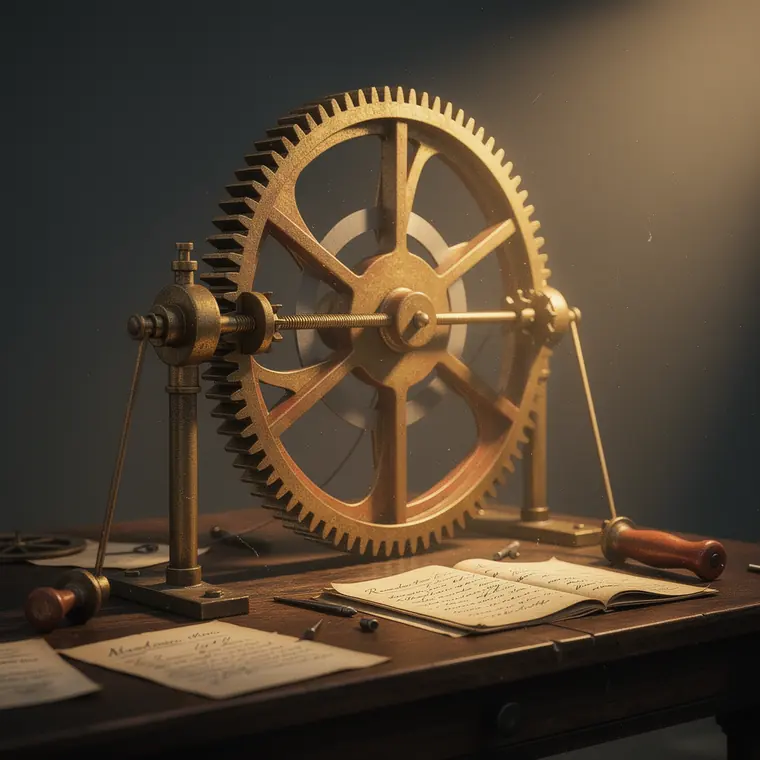
Ramsden's circular dividing engine in his Piccadilly workshop, a large toothed wheel on a spindle driven by a tangent screw and treadle, a blank instrument circle clamped for cutting.
- What it was used for
- Jesse Ramsden used the machine in his London workshop to graduate the scales of octants and sextants for navigation. A wheel with 2160 teeth is turned by an endless screw; six turns move it exactly one degree, and one division of the screw's drum equals ten seconds of arc (Ramsden, Description, 1777). A sextant could be divided in about half an hour. The Board of Longitude paid Ramsden 615 pounds: 300 as a reward and 315 for assigning the property in the engine to the Commissioners of Longitude for the use of the public. In return, from 28 October 1775 to 28 October 1777 he had to instruct up to ten instrument makers in building such engines and divide their instruments at fixed rates: 3 shillings per octant, 6 shillings per brass sextant. The 1775 engine is now at the Smithsonian NMAH; the Philadelphia firm Knox & Shain had bought it from Ramsden's successors.
- What was new
- Circular dividing engines existed before: Henry Hindley built one around 1739, and the oldest surviving example, made in Florence in 1762, is said to be of the Duc de Chaulnes's type (Graces Guide). Ramsden combined speed with accuracy: according to Graces Guide, his first engine (around 1766/67) had errors of up to three seconds of arc, while for the second, dated there to mid-1774, the claimed error was less than one second. The installation included a separate device with which he made the endless screw, and he checked the wheel's graduation by continued bisection. The barb: the 615 pounds bought not only the property in the machine but its dissemination. Ramsden had to disclose it and serve competitors at fixed prices; according to the Science Museum Group, ten or twelve copies of his second design later existed in London.
Further reading
- Jesse Ramsden: Description of an Engine for Dividing Mathematical Instruments (London 1777), Vorwort von Nevil Maskelyne, Volltext Internet Archive
- Smithsonian NMAH: Ramsden Dividing Engine
- Smithsonian, Time and Navigation: Dividing Engine
- Whipple Museum of the History of Science (University of Cambridge), Joshua Nall: Astronomy at Sea
- Science Museum Group Collection: Dividing engine for making sextants and octants
- Graces Guide: Jesse Ramsden – Circular Dividing Engines
- Linda Hall Library: Scientist of the Day – Jesse Ramsden