Maybach Stahlradwagen
1889 · Steel Wheeled Motor Car · Work 244 of 1,871
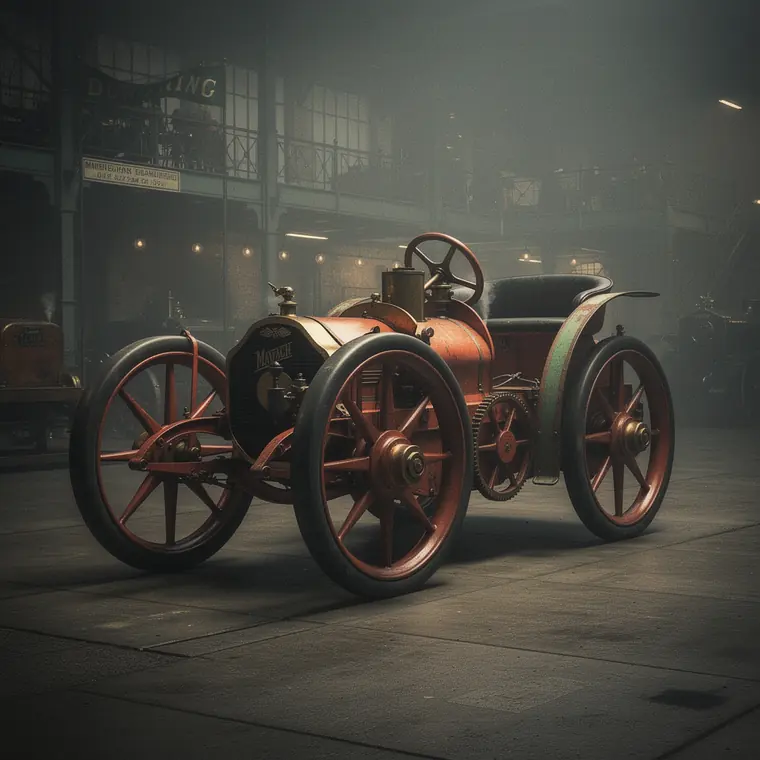
The Maybach Stahlradwagen on the exhibition floor of the Paris world fair, tubular steel wheels with solid rubber tyres, V-twin engine at the rear, four-speed sliding gear with exposed cogs.
- What it was used for
- Gottlieb Daimler and Wilhelm Maybach built the light four-wheeler in Cannstatt as a carrier for their new V engine and presented it at the Paris World Exposition in October 1889. Frame and wheels came from Neckarsulmer Strickmaschinen-Fabrik AG, later NSU; the steel tubes of the frame also carried the cooling water. The engine was meant as a universal drive for road, rail and water vehicles. In Paris, according to the FFVE blog, Daimler met Émile Levassor and René Panhard, and probably Armand Peugeot.
- What was new
- New was the two-cylinder V engine with a 17° cylinder angle (DRP 50839, issued 5 February 1890): 1.5 hp at 600 rpm per the Mercedes-Benz archive, 700 rpm in other accounts; displacement 565 cc according to these. Added to this was Maybach's gear-only four-speed transmission, while Benz still shifted by belt; about 16 km/h in fourth gear. The twist: the Mercedes-Benz archive says the Paris presentation marks the birth of the French car industry. Panhard & Levassor built Daimler engines under licence from October 1889, Peugeot built cars with these engines from 1890 – before Daimler's own company delivered its first production car in August 1892.
Further reading
- Mercedes-Benz Classic Archive: Daimler "Stahlradwagen", 1889
- Mercedes-Benz Classic Archive: 9 June 1889, V-engine patent DRP 50 839
- Mercedes-Benz Classic Archive: October 1889, Paris World Exposition
- Mercedes-Benz Classic Archive: 5 February 1889, licence agreement with Louise Sarazin
- Mercedes-Benz Classic Archive: 29 October 1889, first French engine under Daimler licence
- Mercedes-Benz Classic Archive: 31 August 1892, first DMG production car
- Initiative Kulturgut Mobilität: Weltausstellung Paris 1889 – Der Daimler Stahlradwagen wird gezeigt
- Les Amis de la FFVE: Panhard, Levassor et Louise Sarazin
- Mercedes-Benz Public Archive: Benz Patent-Motorwagen Modell 3 (Riemenschaltung per Handhebel)