Daimler Phoenix
1897 · Front Engined Car · Work 248 of 1,871
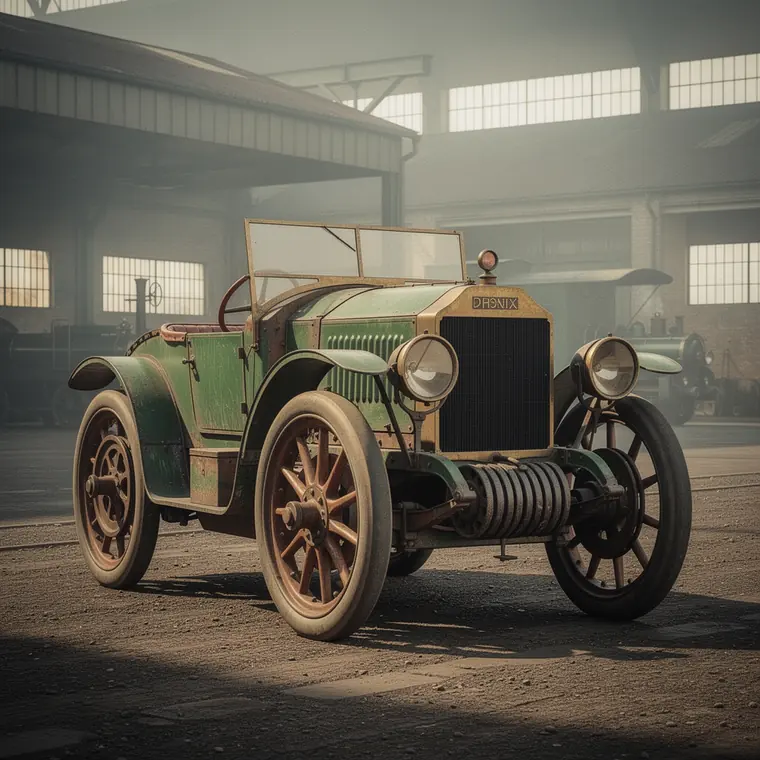
The Daimler Phoenix outside the Cannstatt works, its Phoenix engine carried at the front under a short bonnet, tubular radiator coils ahead of the axle, chain drive, artillery spoked wheels.
- What it was used for
- Daimler-Motoren-Gesellschaft's Phoenix cars were expensive private cars: according to the Mercedes-Benz archive the 4 hp version cost 9,400 to 10,000 marks, almost five times a Benz Velo. An important customer was the businessman Emil Jellinek in Nice. He demanded 40 km/h, resold Daimlers in high society – ten in 1899, 29 in 1900 – and had them raced on the Riviera. On 30 March 1900 works driver Wilhelm Bauer crashed at the Nice–La Turbie hill climb and died the next day. The archive says the exact circumstances have not been clarified. In Mercedes-Benz's account the accident led to the entirely new Mercedes 35 hp.
- What was new
- With the Phoenix, Daimler moved the engine to the front. That was not its own invention: Mercedes-Benz itself writes that it adopted the concept of Panhard & Levassor. Its own contribution was Wilhelm Maybach's tubular radiator, filed for a patent on 24 December 1897 (DRP 104 718), which first appeared in the Phoenix. In September 1898 Jellinek received two road cars with four-cylinder engines, according to the maker the first in the world. When Daimler switched to the front engine is inconsistent within the archive itself: 1897 on one page, 1898 on another.
Further reading
- Mercedes-Benz Public Archive: Daimler Phoenix car 1897–1902
- Mercedes-Benz Public Archive: Daimler motor carriage Phoenix 4 hp (Preise)
- Mercedes-Benz Public Archive: 24 December 1897 (Röhrenkühler-Patent)
- Mercedes-Benz Public Archive: Emil Jellinek
- Mercedes-Benz Public Archive: Wilhelm Bauer
- Mercedes-Benz Public Archive: Daimler Phoenix 23 hp La Turbie racing car 1900
- Mercedes-Benz Public Archive: Daimler Phoenix 12 hp racing car 1899