De Dion-Bouton Motordreirad
1897 · Motor Tricycle with High Speed Engine · Work 253 of 1,871
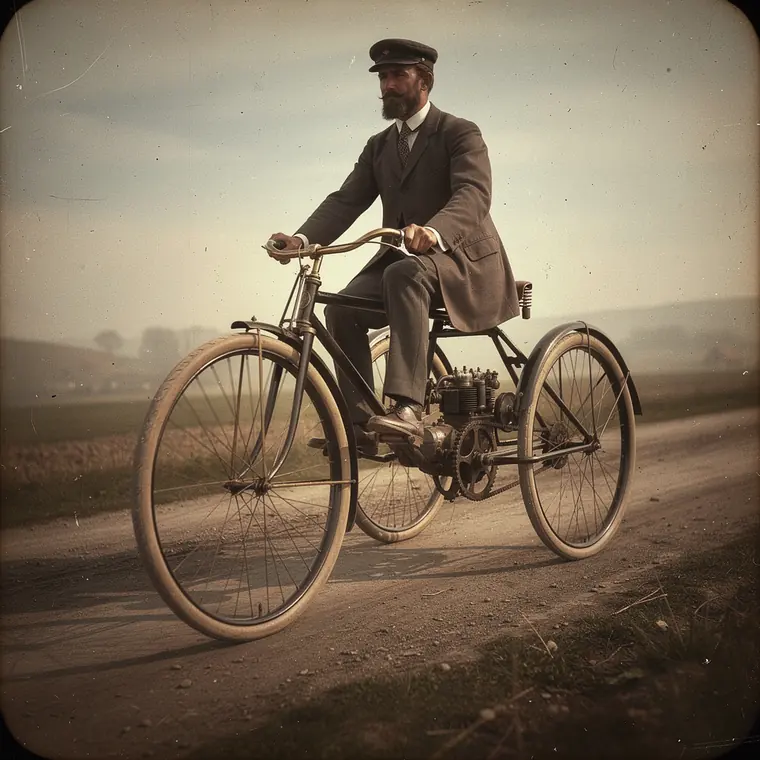
A De Dion-Bouton motor tricycle on an open road: a bicycle-type tubular frame with one steered wheel at the front under the handlebars and two wheels at the rear on a common axle, a small single-cylinder engine hung behind and below that rear axle between the two rear wheels, its finned cylinder upright and its exhaust pipe clearly visible, pedal cranks at the front as on a bicycle, the rider seated on a saddle above the pedals, three wheels touching the ground.
- What it was used for
- The De Dion-Bouton tricycle was the vehicle of the first individual motorists: according to the Louwman Museum it was a bestseller, partly because the French army placed a sizeable order. The Science Museum holds a copy built in Coventry in 1898; such tricycles, the museum says, cruised at about 20 mph, and one averaged 28 mph in the 1899 Paris–Bordeaux race. According to RM Sotheby's over 15,000 were built by the end of production in 1905; RM Sotheby's dates the start to 1897, Grace's Guide to 1896. The firm had previously built steam vehicles. According to Grace's Guide its steam engineer Charles Trépardoux left in 1894 because he did not believe in the internal combustion engine.
- What was new
- What was new was Georges Bouton's engine: small, light and fast-running, with electric ignition. According to the Louwman Museum, Bouton had to develop the ignition specially for it. The engine speed is disputed: figures range from about 2,000 to 3,000 rpm; The Henry Ford gives about 2,000 and says it was "perhaps" the first high-speed, lightweight internal combustion engine. The engine became more important than the tricycle: Grace's Guide estimates that about 150 makes used it, Renault's Type A among them.