Coventry Daimler Wagonette
1897 · Wagonette with Twin Cylinder Engine · Work 263 of 1,871
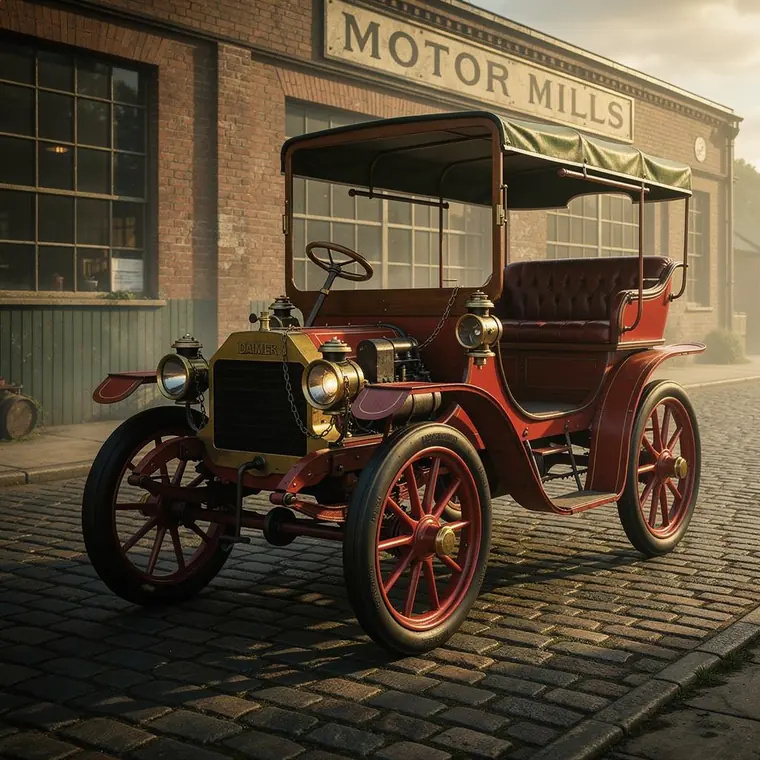
A Coventry Daimler wagonette standing outside the Motor Mills factory, facing rear benches reached by a back step, twin-cylinder engine at the front, side chains, solid tyres, tiller steering.
- What it was used for
- Built at the Motor Mills, a former cotton mill in Drapers Field, Coventry, which Daimler leased in April 1896 for sixty-two and a half years and shared with the Great Horseless Carriage Company, Humber and others. Chassis came from Coventry, bodies from Mulliner of Northampton; the wagonette is a borrowed carriage form with cross benches for several passengers. The first complete Daimler went to Ernest Estcourt early in 1897; Grace's Guide puts a question mark after March. The list price was 373 pounds according to Coventry Transport Museum. One example was bought by George H. Pruen, landlord of the Royal Clarence Hotel at Burnham-on-Sea: it collected hotel guests from the station, served as a wedding car in 1903, later served as a school bus and was retired around 1929, as the Surrey Vintage Vehicle Society tells it, though that page's figures are unreliable. Coventry Transport Museum dates its own example to 1898.
- What was new
- Neither the body style nor the technology was new. The engine patents were licensed German property: Frederick Simms had held the English Daimler rights since 1891 and sold them to Harry Lawson in 1895. What was new was the rate. The National Motor Museum at Beaulieu and the Society of Automotive Historians in Britain agree on 89 chassis in the first year, against one-offs from Lanchester and Wolseley. With it came journeys nobody had demonstrated before: in 1897 Henry Sturmey became the first to drive a Daimler from John o'Groats to Land's End, part of a 1,600-mile tour that Grace's Guide calls the longest on record at the time. The cost lay in the patent business behind it. The Great Horseless Carriage Company, capitalised at 750,000 pounds and so seven and a half times larger than Daimler, resolved to wind up in January 1898; Lawson himself was sentenced in 1904 to a year's hard labour for defrauding shareholders.
Further reading
- National Motor Museum Beaulieu, 1899 Daimler (PDF) (Archivkopie; Original nicht mehr erreichbar)
- Society of Automotive Historians in Britain, Snapshot 471: 1897 Daimler
- Coventry Transport Museum, Daimler Wagonette
- Grace's Guide, Daimler
- Grace's Guide, Great Horseless Carriage Co
- Victoria County History, Warwickshire Bd. 8 (British History Online)
- Surrey Vintage Vehicle Society: 1897 Daimler 6.5 HP Wagonette (Pruen)
- Grace's Guide: Henry Sturmey
- Grace's Guide: Harry Lawson