Bersey Electric Cab
1897 · Electric Cab · Work 264 of 1,871
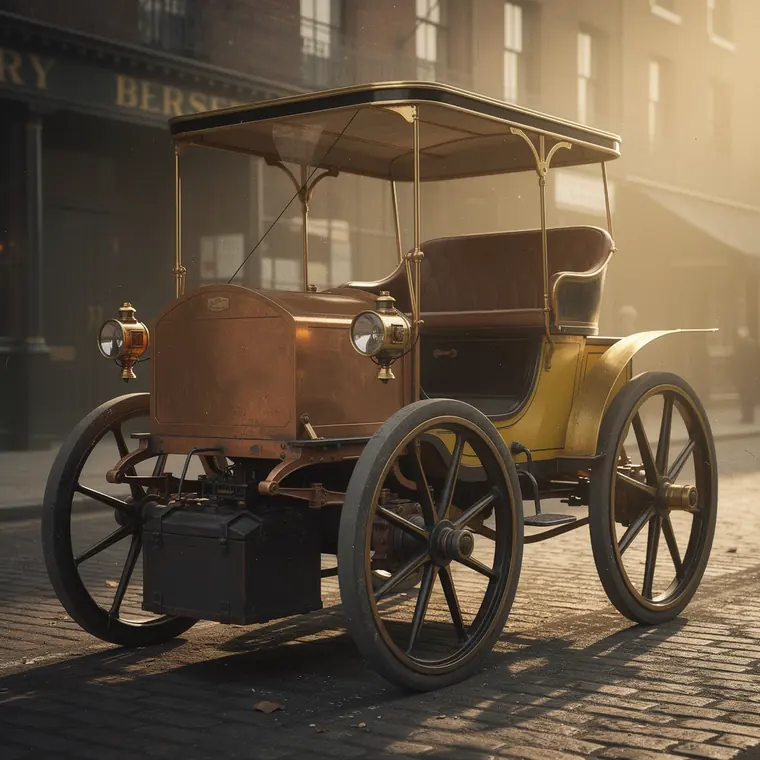
A Bersey electric cab waiting on a London street: an enclosed horse-cab style body on four wheels with solid rubber tyres, the driver perched high on an open seat outside and above the closed cabin, a completely smooth front carrying only a carriage lamp on each side, the battery box slung beneath the floor between the wheels a few inches above the road, the body painted black and yellow, large rear wheels.
- What it was used for
- The operator was the London Electrical Cab Company, registered on 12 November 1896 with 150,000 pounds of capital and a depot in Juxon Street, Lambeth. Walter C. Bersey was not the owner but a salaried manager, 23 years old at the start. Service began on 19 August 1897 with twelve cabs; by December 1898 there were 71 in service, and 77 to 80 were built in all, 24 by the Great Horseless Carriage Company and 50 by the Gloucester Railway Carriage and Wagon Company, with Mulliner bodies. Drivers hired the cabs from the company, according to The Engineer at the same rate as horse cabs. Battery boxes were changed hydraulically in two to three minutes at London's only charging station. By February 1899 the fleet had run more than 500,000 miles. The Engineer puts the first year's loss at 6,200 pounds. Service stopped in August 1899 and the winding-up petition followed in July 1900.
- What was new
- Not the electric car: William Ayrton ran an electric tricycle in 1882, and according to Grace's Guide the company grew in 1896 out of the London bus trials of the Ward Electric Car Company, for which Bersey had worked. What was new was the system: fleet, fare, daily hire, exchangeable battery boxes and a swapping station. The Science Museum calls them "the first self-propelled vehicles for hire on London's roads"; a 1904 verdict reproduced by Grace's Guide goes further, calling them "the first self-propelled service of vehicles started in London, if not in Great Britain". Bersey's patents of 1894 and 1896 describe the conversion of horse-drawn vehicles to electric propulsion, improvements in voltaic batteries and a controller, not the vehicle as a whole; numbers and claims have not been established. The price of silence: some two tonnes of weight ate the tyres, and vibration destroyed the battery's glass plates.
Further reading
- The Engineer, Archiv: August 1897 - The London Electrical Cab (Archivkopie; Original nicht mehr erreichbar)
- Science Museum Group Collection, Bersey Electric Taxi Cab
- Science Museum Blog, London's first ever electric taxi
- Grace's Guide, London Electrical Cab Co
- Grace's Guide, William Edward Ayrton
- Grace's Guide: Walter Charles Bersey
- Grace's Guide: Ward Electric Car Co