Roper Dampf-Velociped
1869 · Steam Bicycle · Work 265 of 1,871
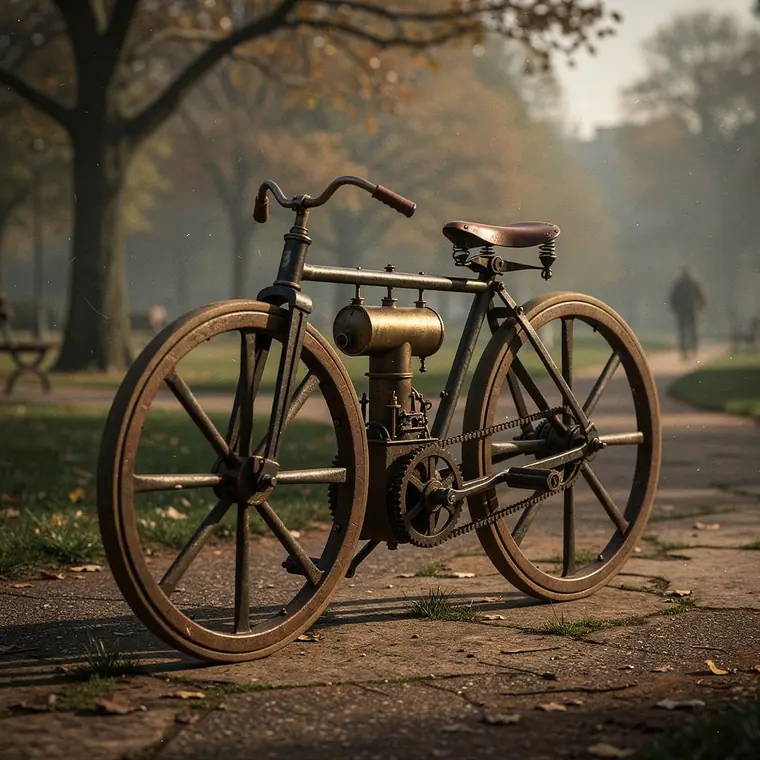
The Roper steam velocipede on a Boston park path, iron tyred wooden wheels, small vertical boiler and firebox between them, twin cylinders driving cranks on the rear hub, chimney behind the saddle.
- What it was used for
- Sylvester Howard Roper was a machinist in Roxbury, near Boston. The Smithsonian, which holds the machine dated to about 1869, records that he demonstrated it at fairs and circuses. His living came from other things: the Roper Repeating Rifle Company at Amherst, formed in 1866, which he gave up in 1868 according to the American Society of Arms Collectors, alongside furnaces and kitchen ranges. No source opened here gives a number of velocipedes built, a price or a buyer; everything points to personal use and showmanship. On 1 June 1896, on a newer machine, a safety bicycle fitted with his engine, he rode a mile in 2 minutes 1.4 seconds on the cycle track at Charles River Park, Cambridge, faster than the racing men set to keep up with him. Moments later the machine left the track. Dr Wolcott, who was called, said according to the Boston Globe of 2 June 1896 that Roper had died before the machine left the track; the only wound was a slight cut over the left temple.
- What was new
- Against the pedal velocipede of the late 1860s, whose wrought-iron frame and wooden wheels the machine takes over, the Smithsonian describes two concrete changes: the saddle served as the water tank, and a twist grip on the handlebar controlled steam and brake at once. Who came first is unresolved, and the best sources say so themselves. Louis-Guillaume Perreaux in France patented his steam velocipede, in 1871 according to the museum database POP, in 1869 according to RideApart; an 1868 patent still concerned a pedal velocipede. Roper never patented his machine. RideApart puts it plainly: "it's unclear which was first." The French museum database POP dates the surviving Perreaux at Sceaux to "vers 1870", and the conservator who restored it to between 1871 and 1873. Roper probably built earlier, Perreaux published earlier.
Further reading
- Smithsonian National Museum of American History, Roper Steam Velocipede, about 1869 (Archivkopie; Original nicht mehr erreichbar)
- Boston Globe vom 2. Juni 1896, wiedergegeben bei History of Hopedale, Mendon and Milford (Archivkopie; Original nicht mehr erreichbar)
- The Henry Ford, Boston Daily Globe Obituary for Sylvester H. Roper (Obj. 2011.0.26.1) (Archivkopie; Original nicht mehr erreichbar)
- American Society of Arms Collectors, Roper Revolving Long Arms (1961, PDF)
- POP / Joconde, Vélocipède Perreaux, Musée départemental des Hauts-de-Seine
- RideApart, Cycleweird: The Roper Steam Velocipede (Archivkopie; Original nicht mehr erreichbar)
- Dalila Druesnes: Restauration du vélocipède à vapeur de Louis-Guillaume Perreaux (Musée de Sceaux; Patente 1868/1871)
- The Vintagent: Sylvester Roper's Steam Velocipedes (2017)