L'Obeissante
1873 · Steam Omnibus · Work 266 of 1,871
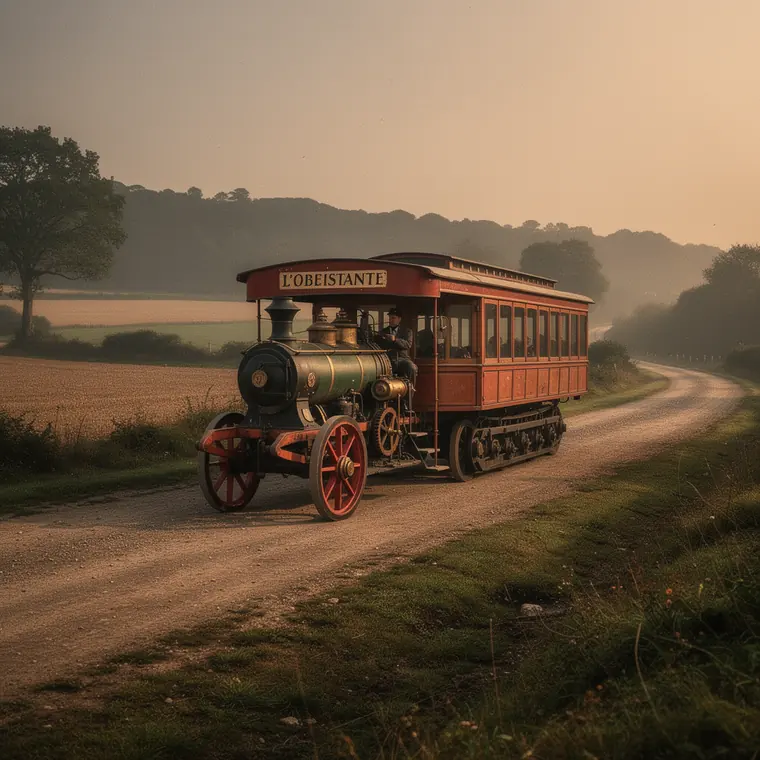
Amedee Bollee's L'Obeissante on the road from Le Mans to Paris, a twelve seat steam omnibus with the boiler standing at the rear, driver at the very front, independently sprung front wheels.
- What it was used for
- Amédée Bollée père, a bell founder at Le Mans, built a steam carriage for twelve passengers plus a conductor and a driver. The Musée des Arts et Métiers, which holds it as inventory number 16851, considers it the first vehicle "de tourisme", that is, not a commercial vehicle for scheduled service. It took many administrative steps: on 26 March 1873 Bollée applied to the prefect of the Sarthe for permission to run his voiture locomobile in the département; for the journey to Paris, Eugène Caillaux, minister of public works, gave his consent on 26 August 1875. On 9 October 1875 Bollée drove from Le Mans to Paris, 230 kilometres in 18 hours including stops for water and meals. Along the way, the museum records, he collected 75 police citations, because the traffic rules made no provision for motor vehicles. They were cancelled after the prefect of police rode in the machine himself at a demonstration.
- What was new
- Steam carriages had run since Cugnot. What was new was the steering: instead of a turntable swinging the whole front axle, two separate stub axles, with independent suspension on all four wheels and two V-twin engines, one per rear wheel. The museum traces the name explicitly to its "grande maniabilité", and its English text to the very smooth steering. The vehicle climbed gradients of twelve per cent and weighed 4.8 tonnes. One French specialist source, Guide Automobiles Anciennes, calls the steering "brevetée"; I could find neither patent number nor filing or grant date, so it remains open whether the double-pivot steering was claimed or merely described. The weight was its own obstacle: for its successor La Mancelle, Bollée nearly halved it.
Further reading
- Musée des Arts et Métiers, Voiture à vapeur dite l'Obéissante
- Musée des Arts et Métiers, L'Obéissante fête ses 150 ans au salon Rétromobile
- Google Arts & Culture / Musée des Arts et Métiers, L'Obéissante steam-powered omnibus (Inv. 16851-0001)
- Arquus, Famille Bollée : autorisation de circulation de la première voiture locomobile
- Guide Automobiles Anciennes, Amédée Bollée l'Obéissante