La Mancelle
1878 · Steam Car with Shaft Drive · Work 267 of 1,871
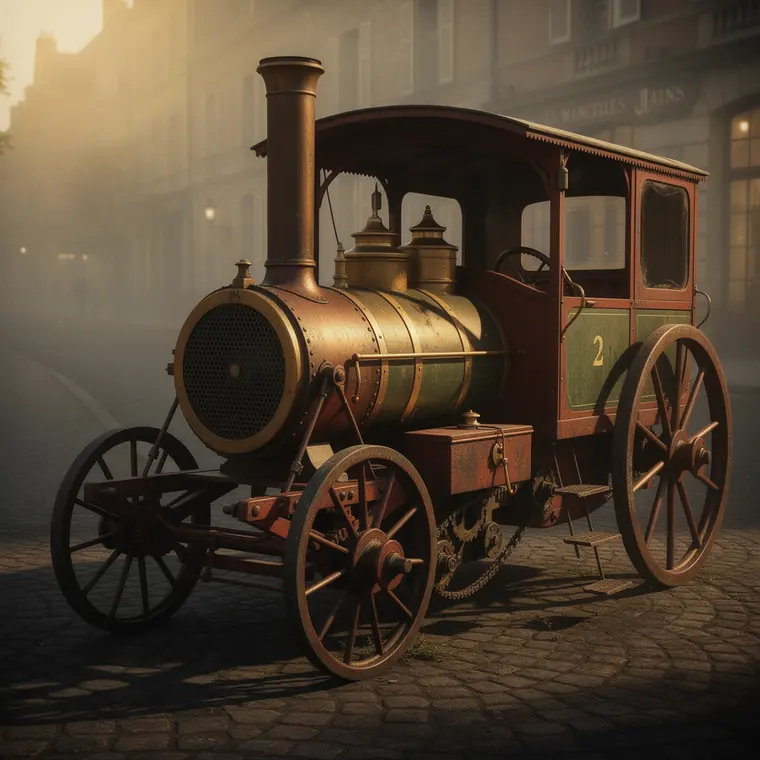
Amedee Bollee's La Mancelle on a Le Mans street, steam engine under a bonnet at the front, vertical boiler behind the passenger compartment, driveshaft and chains reaching the rear wheels.
- What it was used for
- Amédée Bollée père built the car, according to the Château de Compiègne, in four months for the Paris Universal Exposition of 1878, where it won a silver medal; it was then shown in Austria in 1879 and Germany in 1880. It was a customer vehicle for the well-off, with a victoria body to make getting in easier. The specialist site Guide Automobiles Anciennes speaks of some fifty sold. From August 1880, when the car was shown in Berlin, a licensed production ran in Germany, backed by the Arons bank and the locomotive builder Wöhlert; 22 cars were sold in Germany, and the last is said to have been built in 1881. The German royalties promised never materialised; the German company went bankrupt in 1883. Alongside, Bollée built road tractors and utility vehicles. Of some fifty cars one survives, and industry did not save it: Madame Amédée Bollée gave it to the museum at Compiègne in 1927.
- What was new
- Measured against his own Obéissante of 1873: weight nearly halved from 4.8 to 2.75 tonnes, about 40 kilometres per hour, and a small series instead of a single example. The museum that owns it, at Compiègne, describes an engine at the front, rear-wheel drive and independent front suspension. But the line often drawn to the later Système Panhard only half holds: the engine was at the front, the boiler at the back. And the sources differ in nerve. Compiègne stays with "construite en plusieurs exemplaires", "l'une des premières automobiles produites en série" and the soft formula that the car prefigured modern automobiles ("préfigure"); the specialist site l'Automobile Ancienne states flatly that it was "la première voiture produite à plusieurs exemplaires". Who is right depends on how narrowly series is defined; the museum that owns it is the more cautious voice.