Morrison Elektrowagen
1890 · Electric Carriage · Work 270 of 1,871
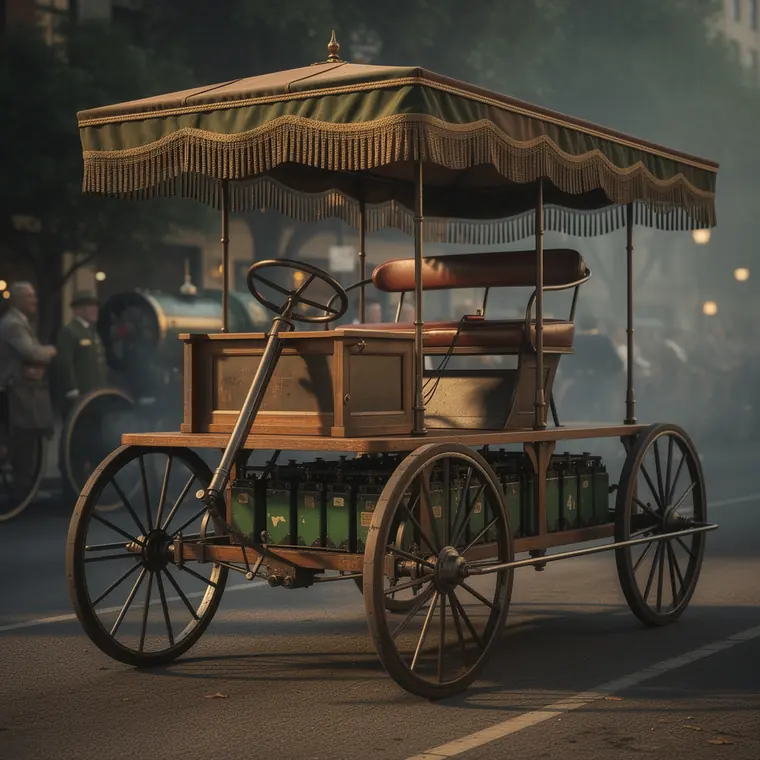
William Morrison's electric carriage in a Des Moines street parade, a converted surrey under a fringed canopy, rows of storage battery cells filling the space beneath the floor, tiller steering.
- What it was used for
- William Morrison, a Scottish immigrant and trained chemist, emigrated to the United States in 1880 and settled in Des Moines, Iowa. His carriage appeared in public on 4 September 1890, in the parade of the second Seni Om Sed celebration; the Des Moines Public Library gives that date, the State Historical Society of Iowa the 1890 parade. It did not stay a one-off: the library records twelve buggies including the original, bodied by the Shaver Carriage Company, at 3,600 dollars each. Twenty-four cells weighing 768 pounds together sat under the first row of seats, driving through a converted streetcar motor of 4 hp. The State Historical Society gives twelve passengers, 14 miles per hour and a range of 50 miles; 20 miles per hour is attributed to Morrison himself. In 1893 Morrison showed an updated version at the World's Columbian Exposition in Chicago, where according to History.com the only other automobile on show was a petrol-driven Daimler quadricycle.
- What was new
- Not the first electric vehicle: according to Grace's Guide, William Ayrton, John Perry's partner, drove an electric tricycle in 1882. What is telling is how carefully the institutions themselves put it. The State Historical Society of Iowa writes "the first successful American electric carriage", the Des Moines Public Library "the first horseless carriage in Iowa (and by some accounts, in the nation)", the Business Record "the first practical electric car". Those qualifications are the finding, not the authors' reticence. What holds up is the step from the 1887 test vehicle to twelve carriages sold. And a reversal sits in his patent behaviour: seven weeks after the parade, on 27 October 1890, Morrison filed US 464,676, granted on 8 December 1891. What it claims is a battery electrode covered with glass wool and held by perforated non-conducting plates. Not one claim concerns a vehicle. The car was the advertising, the battery was the product.
Further reading
- Google Patents, US464676A, W. Morrison, Electrode for secondary batteries
- Project Des Moines (Des Moines Public Library), Automobile Industry in Des Moines
- State Historical Society of Iowa, Goldie at Home: Electric Automobile (PDF)
- Business Record (Elbert Files), The first electric car (Archivkopie; Original nicht mehr erreichbar)
- History.com, Electric Vehicles Timeline (Archivkopie; Original nicht mehr erreichbar)
- Grace's Guide: William Edward Ayrton (Elektro-Dreirad 1882)