Electrobat
1894 · Electric Car with Front Drive · Work 271 of 1,871
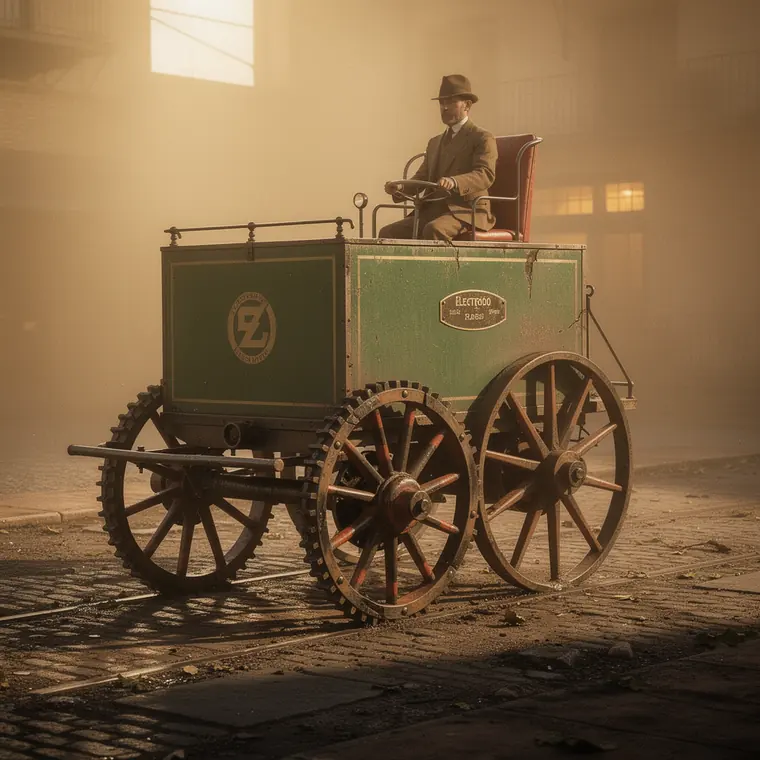
The Electrobat electric carriage in a Philadelphia street, heavy steel tyred wagon wheels, battery box forming the body, driver on a raised rear seat, motors geared to the front wheels.
- What it was used for
- Henry G. Morris, inventor and mechanical engineer, and Pedro G. Salom, electrochemical engineer and later the first treasurer of the American Electrochemical Society, worked in Philadelphia. The first purpose was competition: the Electrobat went to the Chicago Times-Herald race in 1895. From 1897 twelve electric cabs ran in New York; batteries were changed in three minutes in a former Broadway ice-skating rink, the range was about 25 miles and the top speed 20 miles per hour. In that same year 1897 Isaac L. Rice bought the firm, out of which the Electric Vehicle Company grew; by 1899 there were more than 100 cabs, later more than 600, and the collapse came in 1907. On 13 September 1899 Henry H. Bliss was struck and killed stepping off a streetcar by a car of the Electric Vehicle Company: the first pedestrian killed by an automobile in the United States. The vehicle whose very virtue was its silence opened America's road death statistics.
- What was new
- What was new stands in the claims, and it is not the electricity but the vehicle architecture. US 578,651, filed on 6 July 1896 and granted on 9 March 1897, claims among other things a driven front axle with a steered rear axle, two independent motors, one per driving wheel, and rack-and-pinion steering acting on the rear axle. US 603,198, filed on 29 September 1896 and granted on 26 April 1898, claims motor and battery above the front axle with a trailing body carried on the rear axle: a power unit onto which different bodies fit. Only the Woodlands page claims a world first; in the United States Morrison was earlier in 1890, in Europe Trouvé in 1881, Ayrton and Perry in 1882. At the 1895 Times-Herald race the Electrobat took the gold medal, in the committee's own words "notwithstanding the fact that they did not go over the course", for ease of control, safety, quietness and workmanship. The cash prizes went to Duryea and Mueller.
Further reading
- Google Patents, US578651A, Morris & Salom, Motor-propelled vehicle
- Google Patents, US603198, Morris & Salom, Electrically-Propelled Vehicle
- The Woodlands (Philadelphia), The Great Electrobat
- National Geographic, The history of New York's 19th-century electric cabs
- GT Motorsports, The First Horseless Carriage Race (Wortlaut des Komitees)
- Smithsonian Magazine, Henry Bliss, America's First Pedestrian Fatality (Archivkopie; Original nicht mehr erreichbar)
- The Electrochemical Society: From One to 250, Pt. 1 (Pedro Salom)
- Hagerty: The historic Electrobat plied the streets of Gotham
- CentraleSupélec Alumni: 13 juin 1895, 125 ans de la course Paris-Bordeaux-Paris