Stanley Dampf-Runabout
1899 · Steam Runabout · Work 272 of 1,871
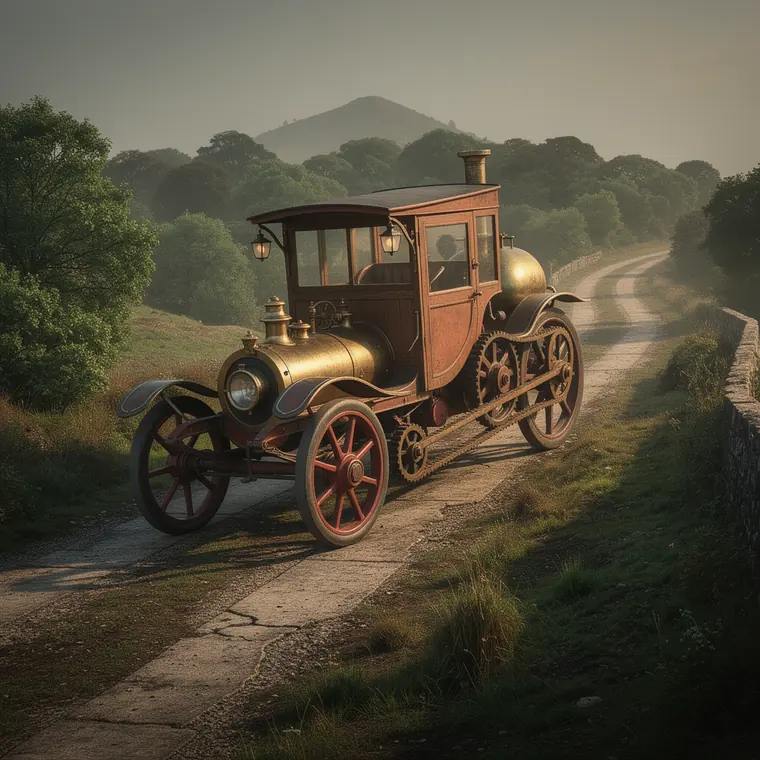
A Stanley steam runabout climbing the Mount Washington carriage road, light buggy body set over a boiler beneath the seat, twin cylinder engine geared to the rear axle, water tank behind.
- What it was used for
- Francis Edgar and Freelan Oscar Stanley, twins from Maine, began their first vehicle on 6 July 1897 at Newton, Massachusetts, and completed it in October. The breakthrough was a public demonstration on 8 November 1898 at Charles River Park in Cambridge: three times round the course, the mile at an average of 27.40 miles per hour. Between the autumn of 1898 and the autumn of 1899 they built and sold 200 steamers; the Henry Ford Museum converts the 600 dollars of the 1899 Locomobile (a Stanley design) into working time: at an average annual wage of 428 dollars, about a year and five months. Thirty to forty minutes of warm-up came with it. In the summer of 1899 the brothers sold their patents, goodwill and manufacturing plant for 250,000 dollars. When F. O. Stanley drove up Mount Washington with his wife Flora a few weeks later, on 31 August 1899, the first motor ascent, with a running time of two hours and ten minutes by his own account, the rights already lay with the Locomobile Co.
- What was new
- Not the first steam automobile. What was new was the series: 200 cars in a year, against the single and near-single production of Europe, of which the roughly 30 De Dion steamers built in all give a measure. The Henry Ford Museum calls the class "fast, cheap, and relatively uncomplicated" and names the limits in the same breath: fuel needs, excessive water consumption and other troubles that dogged the lightweight steamer. The commercial success then belonged not to the brothers but to the buyers of their rights: under the name Locomobile their design became, according to the Audrain Auto Museum, America's largest automobile production with over 5,000 cars in four years. The often-repeated claim that Stanley built more in 1899 than any other American maker could not be verified for the Stanley marque. The Boston Globe quotes the Portsmouth Herald's report of 1 September 1899 on it.
Further reading
- Farm Collector, The Stanley Steamer
- The Henry Ford Museum, 1899 Locomobile Runabout (Artefakt 86756) (Archivkopie; Original nicht mehr erreichbar)
- Boston Globe, Today is the anniversary of the first car going up Mount Washington
- American Heritage, The Stanleys and their Steamer (Februar 1959)
- Audrain Auto Museum, 1900 Locomobile
- RM Sotheby's: 1884 De Dion, Bouton et Trépardoux Dos-à-Dos Steam Runabout (Katalogtext)