Levassor Panhard Nummer Fuenf
1895 · Racing Car with Phenix Engine · Work 274 of 1,871
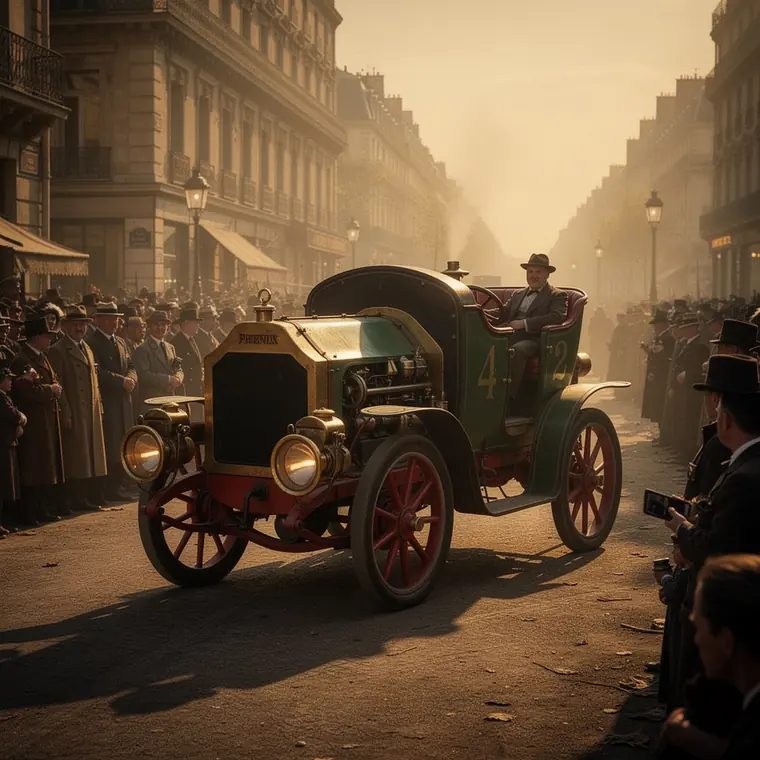
Emile Levassor's Panhard number five arriving at the Porte Maillot in Paris after the Bordeaux run, two seat racing body, Phenix engine under a front box, crowds pressing along the road.
- What it was used for
- Paris-Bordeaux-Paris began on 11 June 1895 at the Arc de Triomphe, with the real start at noon in Versailles. Émile Levassor drove the two-seat Panhard carrying number 5, 605 kilograms, with a Daimler Phénix engine, accompanied by his mechanic Charles d'Hostingue. He did not use the relief drivers arranged for him: at Ruffec the relief man was still asleep at half past three in the morning when Levassor came through, and Levassor drove on. He was first to finish, some five to six hours ahead, over 1,178 kilometres. Paris Musées gives 48 hours 48 minutes for Dalou's model of the Levassor monument in the Petit Palais, as does Caradisiac; Les Doyennes give 47:47, the Encyclopædia Universalis 48:47. He did not get the first prize: it went to Koechlin's four-seat Peugeot, because Levassor's car had only two places. Whether the win was taken from him or whether he chose the light two-seater knowingly at the cost of the prize, the sources differ; Caradisiac reads it as a deliberate choice.
- What was new
- Not the first contest: Paris-Rouen lay a year back, but there was no timekeeping there. What was new was the timed long distance, and a run of two days and two nights with virtually no change of driver. Relief drivers had been arranged, and the rules allowed up to 100 hours. That Levassor barely slept is not stated directly by the sources; what is documented is his refusal of the relief and the scene at Ruffec. The reversal came afterwards: following protests, from the next year the fastest finisher counted as the winner. In precisely that race, Paris-Marseille-Paris in 1896, Levassor crashed while four hours ahead, swerving to avoid a dog. He died in April 1897, on the 14th according to Les Doyennes, on the 18th according to Universalis, over the drawing of a magnetic clutch. Bill Boddy in Motor Sport Magazine attributes the death to the accident; Encyclopædia Universalis puts it more cautiously, saying he never really recovered.
Further reading
- Paris Musées / Petit Palais, Monument à Levassor
- Encyclopaedia Universalis, Émile Levassor
- CentraleSupélec Alumni, 13 juin 1895, 125 ans de la course Paris-Bordeaux-Paris
- Bill Boddy, Life and death on the open road, Motor Sport Magazine (Juni 2004)
- Caradisiac, Le jour où une auto à pétrole est arrivée la première d'une course longue distance
- Les Doyennes de Panhard & Levassor, Émile Levassor
- Transportation History: 1895 - the grande launch of one of the earliest motorcar races