L'Eclair
1895 · Racing Car with Pneumatic Tyres · Work 275 of 1,871
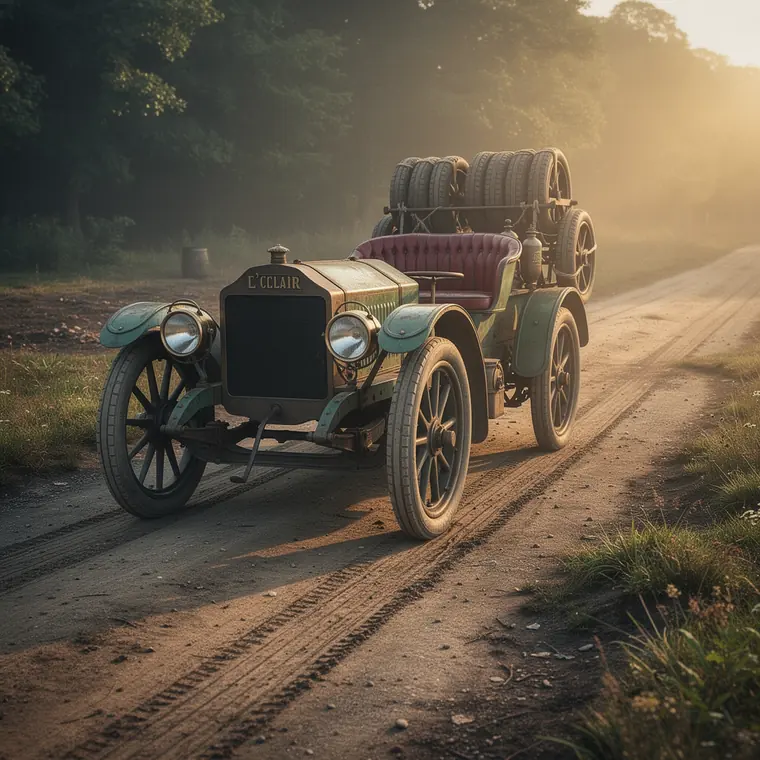
The Michelin brothers' car L'Eclair on the Paris to Bordeaux route, the first pneumatic tyres fitted to a motor car, wandering track across the road, spare tyres and pumps stacked behind the seats.
- What it was used for
- André and Édouard Michelin prepared three cars for Paris-Bordeaux-Paris in 1895; two failed before the start. The third was a Peugeot Type 5 whose 2.5 hp engine was replaced by a 4 hp Daimler marine engine overhanging at the rear. With its tool chest and spares the car weighed just under 1,160 kilograms: a rolling tyre workshop. Three weeks before the start the brakes failed after a wheel change, the car ran into a telegraph pole and burned; the hired drivers then refused, so the brothers drove it themselves. They passed the Tours control on 12 June at 9.38 pm, Bordeaux on 13 June at 12.45 pm, more than 24 hours behind, and Paris on 15 June at 7.50 pm, tenth and last. They arrived and were not classified, because the rules allowed no more than 100 hours. Peugeot was offering pneumatic tyres as an option from 1896.
- What was new
- Not the pneumatic tyre: it had existed since Dunlop's bicycle tyre of 1888, but glued on, so that a change took a long time because the glue had to dry. Michelin's innovation was removability; according to L'Aventure Peugeot Édouard Michelin asked his engineer for a fixing that could be undone in a quarter of an hour. With it Charles Terront won Paris-Brest-Paris in 1891 over 1,200 kilometres, in 72 hours according to L'Aventure Michelin. On a motor car what was new was that air did the springing, where the competition ran on iron tyres or at best on solid rubber. The name does not come from speed: the overhanging rear engine unloaded the front axle, the car ran in zigzags, and that is why it is called lightning. The often-quoted number of punctures, 22 or more than 50, could not be confirmed at Michelin, at Peugeot, at Hagerty or in the museums: none of those sources gives any number at all.
Further reading
- L'Aventure Peugeot, Zoom sur l'Éclair
- L'Aventure Michelin, Pressemappe 2019 (PDF)
- Hagerty, How Michelin tested the first inflatable tires
- l'Automobile Ancienne, Michelin L'Éclair (1895)
- Cnum / CNAM, Faksimile des Michelin-Patents 1891 mit Fundstellenangabe
- Science Museum Group: Pneumatic cycle tyre, 1888 (Dunlop)