La Jamais Contente
1899 · Electric Record Car · Work 277 of 1,871
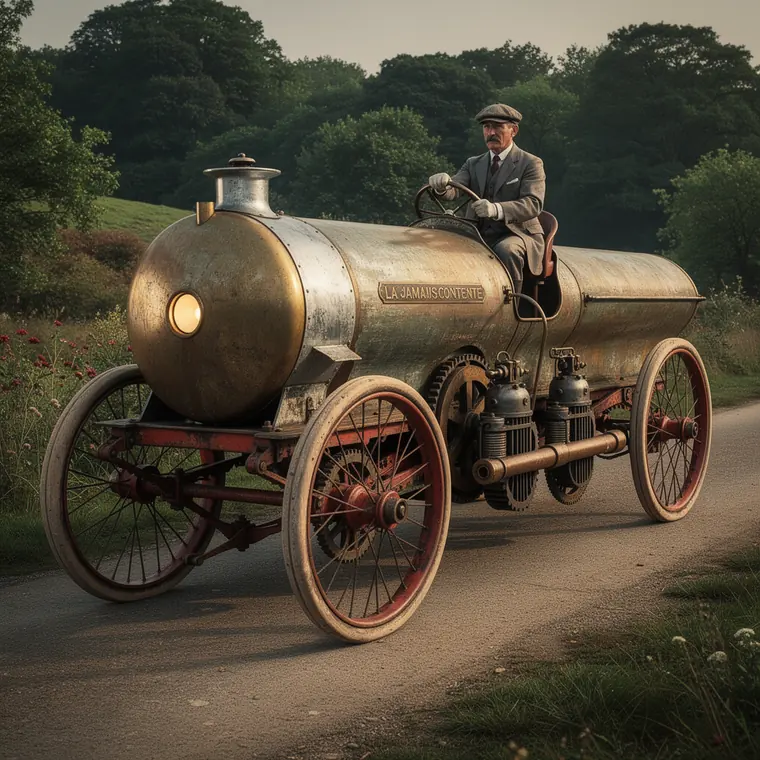
La Jamais Contente on the road at Acheres, torpedo shaped light alloy shell on tall wheels, driver sitting high above the body, two electric motors driving the rear axle directly.
- What it was used for
- Not a working car but a record machine and an advertisement for Camille Jenatzy's own business: his Compagnie Générale des Transports Automobiles built and sold electric cabs and commercial vehicles. The Partinium body was made, according to the Château de Compiègne, by Léon Auscher together with Edmond Rheims; Fulmen supplied the batteries, Michelin the tyres. The Brussels museum site Museums in the Park gives 105.88 km/h for the run at Achères on 29 April 1899; the Compiègne museum gives only 1899, and the dimensions 3.60 × 1.58 × 1.35 m. Weight and power are disputed: 750 kg and about 68 hp per Museums in the Park, 1,100 kg and about 55 hp per l'Automobile Ancienne. The car entered the museum in 1933 as a gift from Fulmen and Jenatzy's widow - that is, from the battery supplier whose product made up almost half the weight.
- What was new
- Neither the first electric car nor the first land speed record: Gaston de Chasseloup-Laubat held it several times with an electric Jeantaud and traded it back and forth with Jenatzy in the same months. What was new was the combination - a streamlined torpedo body of the light aluminium alloy Partinium, wheels of equal size, two motors directly on the rear axle. The owning museum puts the claim narrowly itself: "première automobile à être chronométrée en 1899 au-delà de ce même cap symbolique des 100 km/h". Part of that record is an attempt on 31 March 1899 that was not homologated because the run-up was 200 metres out - the record came only at the second try.
Further reading
- Château de Compiègne, Sammlungsnotiz: Automobile électrique La Jamais Contente
- Château de Compiègne, Pressemappe Vitesse (PDF)
- Museums in the Park / Autoworld Brüssel: La Jamais Contente - First Speed Record
- l'Automobile Ancienne: La Jamais Contente (1899)
- Mercedes-Benz Konzernarchiv, Classic M@RS: Fahrerdatenblatt Camille Jenatzy