Maybach Spritzduesenvergaser
1893 · Float Jet Carburettor · Work 278 of 1,871
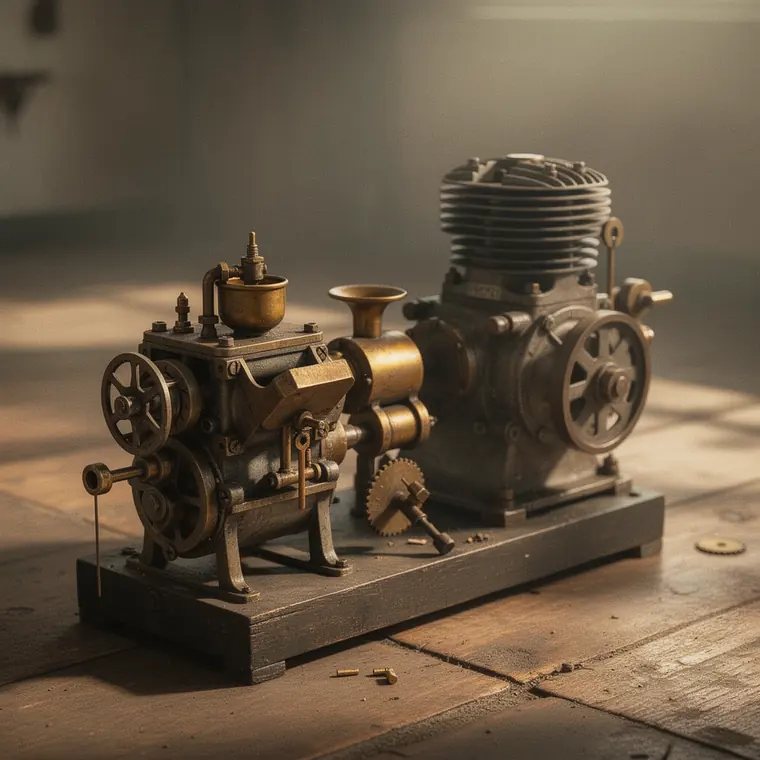
Maybach's float feed spray carburettor opened on a Cannstatt workbench, brass float chamber, needle jet and throttle flap, a short intake pipe joining it to a Phoenix engine cylinder.
- What it was used for
- In 1893 Wilhelm Maybach was not employed by the Daimler-Motoren- Gesellschaft. From October 1892 he had rented, at Gottlieb Daimler's expense, the hall of the closed Hotel Hermann in Cannstatt, where, according to the Mercedes-Benz corporate archive, he worked on with twelve workmen and five apprentices; the carburettor belongs to that workshop. Sources differ on what first carried it: the Neue Deutsche Biographie names an upright 3.5 hp engine for stationary use, while the corporate archive lists it on its "Riemenwagen" page as a further product of that workshop, of which about 150 were built at DMG from 1895. Maybach himself was removed as technical director after Max von Duttenhofer's death in August 1903, confined to an "inventor's office" away from development, and left DMG in April 1907.
- What was new
- The difference is a change of principle: in the surface carburettor air passed over a reservoir of petrol and took up whatever evaporated, while in the jet carburettor the low pressure at a constriction in the intake tears the fuel out of a nozzle and atomises it, so that all its constituents are taken up continuously and no residue is left. Who was first is unresolved: Donát Bánki and János Csonka filed in Budapest on 11 February 1893, half a year before Maybach's French filing of 17 August 1893. What is documented is only which design prevailed; the list of patents in the Neue Deutsche Biographie records a French and a British patent of 1893 for the jet carburettor, but no German one.
Further reading
- Hans Christoph Graf von Seherr-Thoß, Maybach, Wilhelm, in: Neue Deutsche Biographie 16 (1990), S. 523-525
- Mercedes-Benz Konzernarchiv, Classic M@RS: Daimler Riemenwagen, 1895-1899
- Mercedes-Benz Konzernarchiv, Classic M@RS: Personenseite Wilhelm Maybach
- Deutsches Historisches Museum / LeMO: Biografie Wilhelm Maybach
- PestBuda: The meeting of two brilliant Hungarians with the florist – Bánki and Csonka patented the carburettor 130 years ago