Bosch Magnetzuendung
1897 · Low Tension Magneto Ignition · Work 279 of 1,871
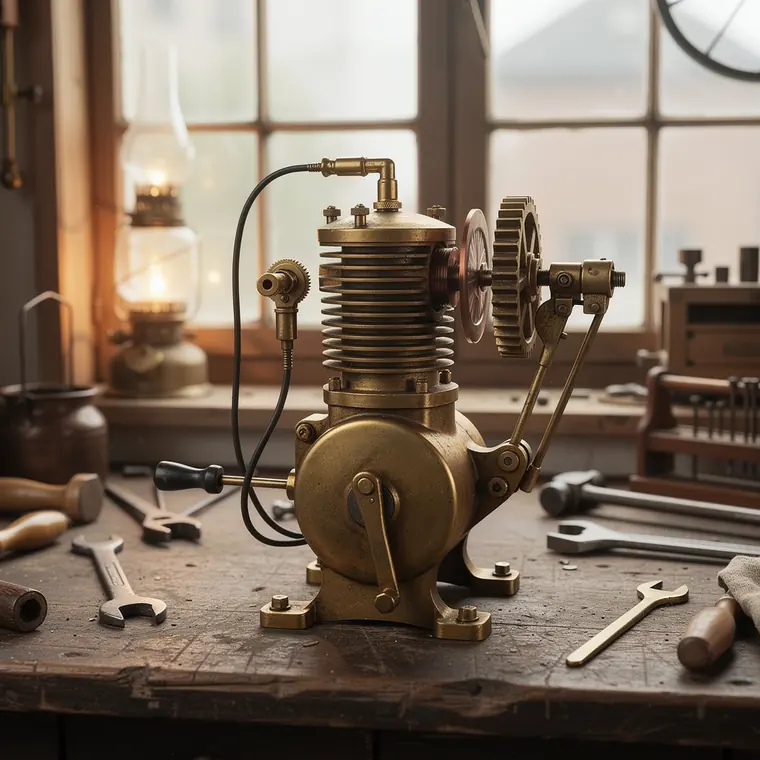
A low voltage magneto clamped to a De Dion single-cylinder tricycle engine standing on a Stuttgart workbench, the small finned engine cylinder upright, the magneto beside it a compact assembly with an armature oscillating between magnet poles, a contact breaker lever, wires running to the cylinder, hand tools around on the bench, the room lit by daylight from the window and an oil lamp.
- What it was used for
- Until 1897 Bosch magnetos sat on stationary engines built into factories and mills. The step into a vehicle was ordered by a customer: in October 1897 the English engineer Frederick Richard Simms, a member of the supervisory board of the Daimler-Motoren-Gesellschaft, approached Bosch and ordered three magnetos for the engine of a De Dion-Bouton tricycle; the trials in November succeeded. By Bosch's own account only the apprentice and later board member Max Rall dared the first test ride, and it ended in the neighbouring wine merchant's empty casks. That business made the company - and Bosch replaced its own success itself: in 1925 it introduced the cheaper battery ignition, and by 1931 forty-six of fifty-five German car types had one.
- What was new
- Each stage has its own novelty, and none of them is the invention of ignition. In 1887 Bosch copied a Deutz magneto - the Deutz design was unprotected - and replaced the heavy bar magnets with smaller U-shaped ones. The step of 1897 was different: instead of the heavy armature swinging, only a light sleeve swings around it, which removed the inertia limit that had tied the device to stationary engines at about 120, at best 200 to 300 revolutions a minute - car engines ran at over 1,000, and on the De Dion tricycle measurement gave about 1,800 by Bosch's own account. When Arnold Zähringer solved this is disputed: 1896 according to the trade press, but according to Bosch's own history magazine only in response to the 1897 measurement. The high-tension magneto with a spark plug came only in 1902, from Gottlob Honold.
Further reading
- Bosch: Magazin zur Bosch-Geschichte, Sonderheft 1 - Robert Bosch, Leben und Werk (Beitrag Die zündende Idee, Dieter Schmitt)
- Bosch: Magazin zur Bosch-Geschichte, Sonderheft 3 - Der Weg zum Global Player
- Bosch: 1886-1905 - Von der ersten Werkstatt zur Fabrik
- konstruktionspraxis (Vogel), Monika Zwettler: Die Entwicklung der Zündung, 3.6.2022
- kfztech.de, Johannes Wiesinger: Geschichte der Zündung, Teil 2