Vacherons Lenkrad
1894 · Front Engined Car with Steering Wheel · Work 280 of 1,871
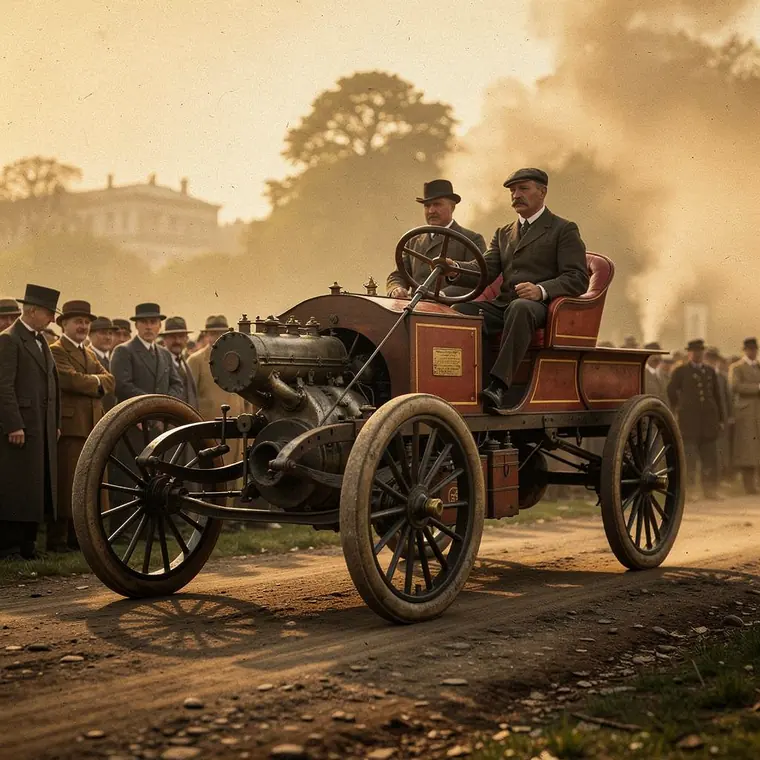
Alfred Vacheron's Panhard fitted with a steering wheel on an inclined column at the Paris to Rouen trial, front engine under a box, occupants on a high bench, spectators lining the road.
- What it was used for
- Alfred Vacheron of Monthermé was not a manufacturer but an owner: he modified his 4 hp Panhard et Levassor himself and drove it on 22 July 1894 over the 126 kilometres of the "Concours des voitures sans chevaux" announced by Pierre Giffard for Le Petit Journal. What was judged was not speed but usability; by the wording of the rules the car was to "être sans danger, aisément maniable pour les voyageurs et de ne pas coûter trop cher sur la route". According to the Mercedes-Benz corporate archive, 21 of 102 entries started. Vacheron came in eleventh or twelfth - the corporate archive gives 8 hours 41 minutes, other result lists 8:42:30 - and received a shared fourth prize of 1,000 francs - the 5,000 francs of the first prize were split between Panhard et Levassor and Peugeot, that is, the manufacturers.
- What was new
- What was new was not a wheel for steering but the inclined steering column with a wheel in place of the upright lever - and this is exactly where the attribution becomes the problem. The Mercedes-Benz corporate archive states flatly that Vacheron's vehicle was "the first car ever to have an inclined steering column and steering wheel"; the Helck collection (Vanderbilt Cup Races) hedges with "Considered to be the first automobile with a steering wheel". The chain of evidence ends in secondary literature; none of the accounts consulted cites a contemporary source of 1894. What can be documented is how long it took: the winner of the first American race was still steering "by the same lever" in November 1895, and the Peugeot Vintage site singles out the 1901 Type 36 for having "a steering wheel instead of a handle".
Further reading
- Mercedes-Benz Konzernarchiv, Classic M@RS: Panhard & Levassor, 1894-1896
- Goodwood: The 1894 Paris-Rouen Trial - the race that wasn't a race
- Peugeot Vintage: The steering wheel, quite interesting
- Vanderbilt Cup Races (Helck Family Collection): The 1894 Paris-Rouen Race
- The Chicago Motocycle Race, Scientific American, 7. Dezember 1895 (Lenkhebel des Siegerwagens)
- Mercedes-Benz Public Archive: First automobile race Paris–Rouen 1894 (Ergebnistabelle)
- BnF Gallica: Album Girard, Paris–Rouen 1894 (Vacheron, Peugeot mit Lenkrad), f. 18