Derby Rib Frame
1758 · Rib Knitting Frame · Work 284 of 1,871
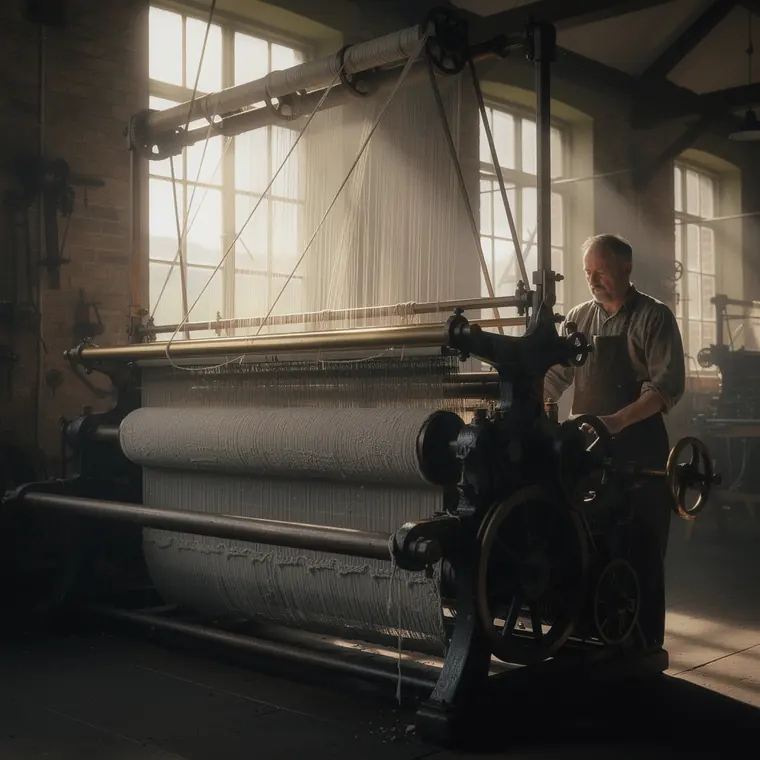
Jedediah Strutt's Derby rib attachment clamped to a stocking frame in a Derbyshire workshop, its second row of vertical needles working between the frame's horizontal bearded needles.
- What it was used for
- By Felkin's account William Woollatt was a hosier in Derby about 1750; he put the question of how ribbed hose might be made to his brother-in-law Jedediah Strutt. The device was an iron frame hung on jointed arms in front of the ordinary stocking frame, its needles set nearly perpendicular and entering between the horizontal ones of the frame. It made the tops of socks, wristbands, ankle bands and white cotton hose; the goods were called "Derby ribs" from the town where they were first made. The firm of Need, Strutt and Woollett carried on the business until the patents expired in 1773; in Derby the product was principally silk hose, and it stayed in the family's hands until 1803. The money bought something else: in 1771, on payment of £500, Need and Strutt joined Arkwright's partnership.
- What was new
- There were two grants, not one: patent no. 722 of 19 April 1758 and patent no. 734 of 10 January 1759, both to Jedediah Strutt, wheelwright of Blackwell, and William Woollatt, hosier, fourteen years each. The specification describes a set of "turning needles" fixed to a stocking frame. The difference from what went before is that Strutt altered nothing in Lee's frame - if the attachment is not put into action the frame still knits plain web; Felkin insists this matters as much to Lee's fame as to Strutt's. There were precursors: Roper, Bowman and others had worked under great difficulties at producing ribbed hose by machinery, and the tuck presser of about 1740 is ascribed by some to Paris and by others to Dublin - Felkin says himself that there does not seem to be proof of either. The Derwent Valley Mills World Heritage Site states that there is more than one version of the story.
Further reading
- Great Britain Patent Office (Woodcroft), Titles of Patents of Invention 1617-1852, Part I (Nr. 722 und Nr. 734 im amtlichen Wortlaut)
- William Felkin, A History of the Machine-wrought Hosiery and Lace Manufactures, 1867
- Derwent Valley Mills World Heritage Site: Key figures – Jedediah Strutt (1726–97)
- Derbyshire Record Office D3772/E45/3, Derby Rib machine patent (schottische Bestätigung 1767), über Google Arts & Culture