Kay Drop Box
1760 · Drop Box · Work 285 of 1,871
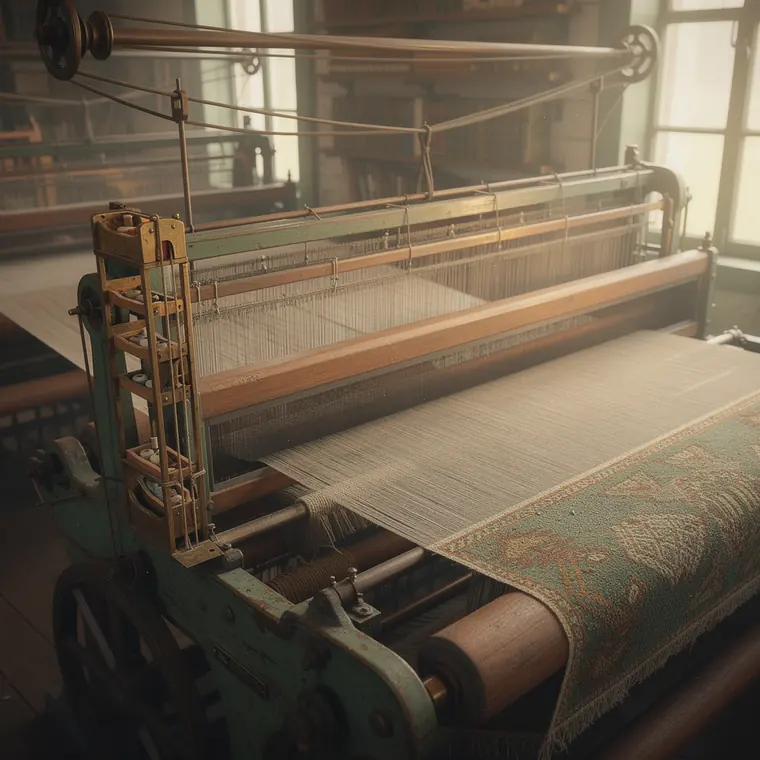
Robert Kay's drop box at the end of a handloom sley in a weaver's cottage, three stacked shuttle cells raised by a cord to change the weft in use.
- What it was used for
- Robert Kay of Bury, son of John Kay, built the drop box for the handloom: with it the weaver could use at pleasure any one of several shuttles carrying weft of different colours, without taking them from the lathe and replacing them. At each end of the batten sat a box with shelves one above another; when a shelf is brought level with the shuttle race, the shuttle on it stands in line with the picker. How many there were the sources give differently: Guest in 1823 and Baines in 1835 say three, while Barlow in 1878 writes that the box is usually made for two only, though three or more can be used. By Guest's account 1760 is also the year in which his father's fly shuttle finally came into use among the cotton weavers - and that same success had driven the father out: in 1753 a mob ransacked Kay's house at Bury and destroyed his models and drawings; he went to live in Paris.
- What was new
- The father made one shuttle fast and one-handed; the son made the fast shuttle able to carry colours, by setting several boxes one above another at both ends of the lathe and making the picker slide horizontally instead of vertically, so that it could reach over whichever shelf had been brought opposite it. An elastic cord then drew it out again, since otherwise the box could not be raised or lowered. No patent for the drop box is recorded in the official patent index for 1617 to 1852; the Kay grants out of Bury - 515, 542, 561, 612 - are all John's. That is an absence in the register, not proof that none was ever applied for. The earliest account of the invention rests on a family manuscript that Robert's son Samuel Kay lent to Richard Guest some sixty years later, which Guest drew on in 1823; Baines in 1835 quoted Guest, citing him.
Connections
Every connection names its kind. “Forerunner” on its own would be a claim.
- Follows fromFlying Shuttle1733Barlow 1878: the fly shuttle was intended for the use of one shuttle only; to use two or more on the same principle, Robert Kay, son of the inventor John Kay, invented the drop box about 1760. Two pickers as in the ordinary fly loom, but sliding horizontally instead of vertically.Source: Alfred Barlow, The History and Principles of Weaving by Hand and by Power, London 1878, S. 92-94 und S. 287 (Volltext) · Edward Baines, History of the Cotton Manufacture in Great Britain, London 1835, S. 116-117 (zitiert Guest 1823, S. 8)
Further reading
- Richard Guest, A Compendious History of the Cotton-Manufacture, 1823 (Ursprungsstelle, S. 8, mit Offenlegung der Quelle S. 30)
- Alfred Barlow, The History and Principles of Weaving by Hand and by Power, 1878 (Mechanik der drop box, S. 92-95)
- Great Britain Patent Office (Woodcroft), Titles of Patents of Invention 1617-1852, Part I und II (kein Patent auf Robert Kay)
- Edward Baines, History of the Cotton Manufacture in Great Britain, 1835 (S. 116 f., zitiert Guest)
- Bury Art Museum: Famous local people – John Kay (1753, Paris)