Flying Shuttle
1733 · Flying Shuttle · Work 281 of 1,871
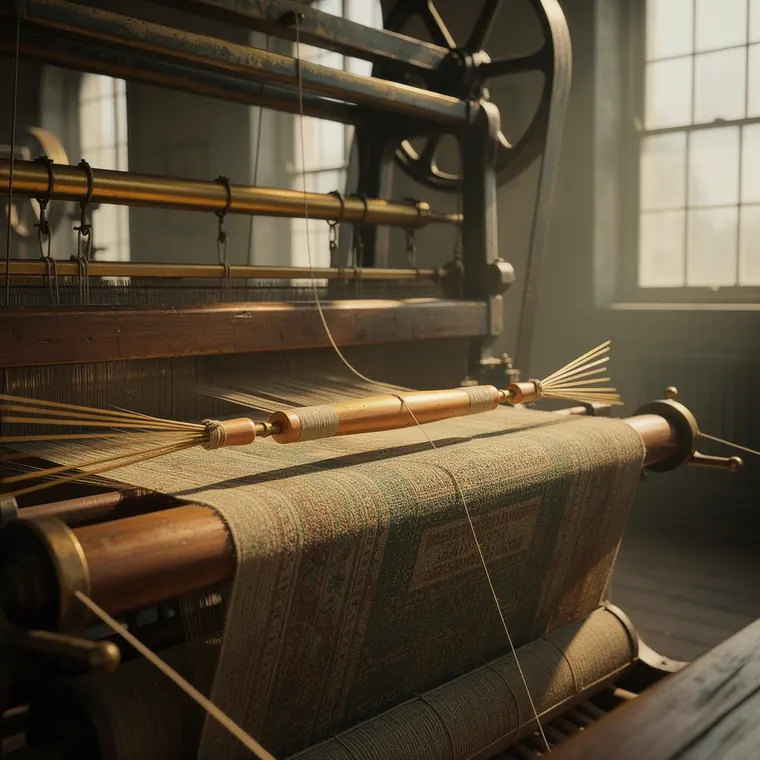
John Kay's flying shuttle on a handloom, the shuttle caught mid-flight in its race, picking sticks and cords at either end, warp threads stretched taut across the frame.
It doubled the width one weaver could work, and in doing so made spinning the bottleneck. Almost every spinning machine of the next forty years is an answer to that single imbalance.
- What it was used for
- In cottage weaving and then in the Lancashire manufactories. One weaver could now make cloth wider than his own reach, without a second man standing at the far edge.
- What was new
- The loom was not new; the separation of hand from shuttle was. The shuttle now crosses the shed by itself, flicked rather than passed. Kay patented it in 1733; it only took hold in the 1750s, and Kay himself gained little from it.
Connections
Every connection names its kind. “Forerunner” on its own would be a claim.
- Made possibleThe Jacquard Head1804The Jacquard head sits on the loom that this mechanism made economic in the first place.
- Made possibleKay Drop Box1760In 1760 Robert Kay, son of John Kay, extended his father's flying shuttle from one shuttle to two or more, held above one another in a box at the side of the loom. The drop box sits on the shuttle race and cannot be built without it.Source: Robert Kay (Grace's Guide to British Industrial History)