The Jacquard Head
1804 · Jacquard Mechanism · Work 564 of 1,871
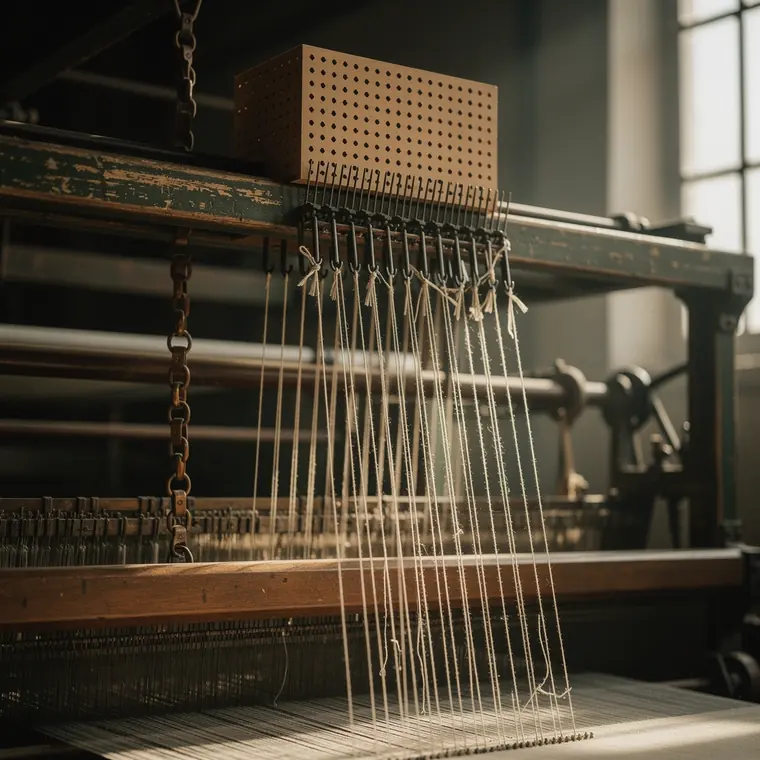
The Jacquard mechanism mounted high above the loom, a square prism turning to present one perforated card at a time to a grid of horizontal needles, each card laced to the next and hanging in a chain down the side, hundreds of harness cords descending in parallel lines from the hooks into the warp below, the cards a buff brown, the needles and hooks in dull steel, the timber frame in worn oak, a silk weaver's workshop in Lyon with daylight from a tall window raking across the cords, the loom body below dropping out of focus.
The first machine whose behaviour was set not by how it was built but by an interchangeable store of instructions. A new pattern meant new cards, the same machine. That is the idea all programming later grows out of.
- What it was used for
- For figured silk in Lyon - flowers, scrollwork, whole pictorial hangings that until then had needed a drawboy sitting beside the weaver lifting warp threads by hand.
- What was new
- The interchangeable store of instructions. Forerunners existed: Bouchon 1725, Falcon 1728, Vaucanson 1745 - Jacquard put their parts together and made them work. The new thing is not the punched card but that a new pattern costs only new cards, not a new machine.
Connections
Every connection names its kind. “Forerunner” on its own would be a claim.
- Follows fromVaucanson's Cylinder1745Vaucanson's perforated cylinder of 1745 solved the same problem with a fixed drum. Jacquard replaced it with a chain of separate cards - any length, and changeable at will.
- Made possibleThe Card Reader1836Babbage's card reader takes the mechanism over unchanged.
- Made possibleHollerith's Tabulator1890Hollerith's tabulator stands in the same line: punched cards carrying facts that a machine reads mechanically.
- Follows fromFalcon's Card Chain1728The Musées Gadagne trace the Jacquard mechanism back to three parts; from Falcon, 1728, comes the card system whose cards are laced into an endless chain, which is what permits uninterrupted control. That chain is what runs over Jacquard's prism.Source: Métier équipé d'une mécanique Jacquard (Musées Gadagne, Musée d'histoire de Lyon)
- Follows fromBouchon's Punched Tape1725In 1725 Bouchon was the first to control the draw loom by a perforated band of paper. According to Mingei, Vaucanson took over this punched roll for his loom, which Jacquard found at the Conservatoire. The Computer History Museum: Jacquard took much of Vaucanson's concept while incorporating aspects of both Bouchon's and Falcon's designs. The transmission is indirect.Source: Artifact Adopted! Preserving the Legend of J. M. Jacquard (Computer History Museum) · Story of the Jacquard Invention (Mingei, EU-Projekt für handwerkliches Kulturerbe)