Vaucanson's Cylinder
1745 · Perforated Drum · Work 563 of 1,871
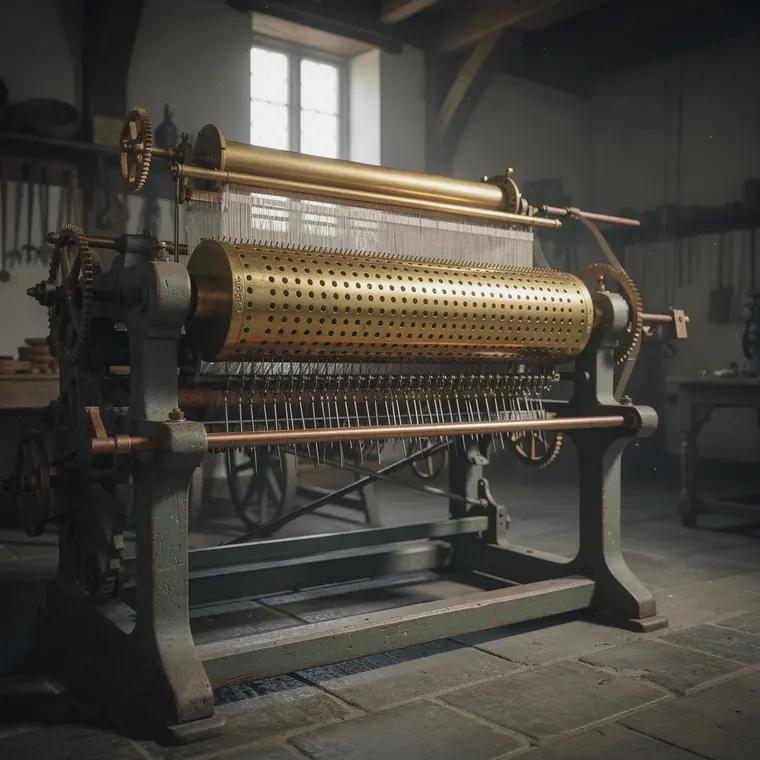
A perforated metal cylinder mounted at the top of the loom in the place of a card chain, its surface pierced with rows of round holes, turning by ratchet against a bank of hooks and needles, the whole mechanism in polished brass and steel, the loom standing on its own as a self-acting automaton, the frame around it open and bare, the machine set in a stone-floored workshop lit by daylight from a high window, the brass warm against the grey of the surrounding iron and timber, the rear of the mechanism fading out of focus.
- What it was used for
- Jacques de Vaucanson was a builder of automata and, from 1741, inspector of the silk manufactures; his loom of 1745 was meant to partially automate the work of the drawboy and the weaver. Instead of a chain of cards he laid the perforated paper on a large round cylinder about twelve inches in diameter, which moved out and back at every stroke and turned one tooth further as it did so. The tail cords and simples of the drawloom were gone, the hooks stood on top of the loom and the harness hung from them. The machine was driven by a hand crank. It never entered silk production: "The machine did not find commercial application." It survives at full size in the Conservatoire des arts et métiers in Paris.
- What was new
- What was new was that the machine made the drawloom fully self-acting instead of merely assisting it. Barlow writes in 1878 that Vaucanson did away entirely with "the cumbrous tail-cards of the draw loom" and, with the rising and falling griffe, introduced the part that brought the machine "very nearly resembling the actual Jacquard". The price was its ceiling: according to Barlow the cylinder worked only one row of needles. Vaucanson therefore went forward in mechanism and backward in capacity compared with Falcon's multi-row chain of cards. That Jacquard learned from this machine is documented by the repair he was brought to Paris for: Bell writes in 1895 that Jacquard was "brought to Paris to repair Vaucanson's loom about 1804".
What the sources leave open: The year of construction is disputed: 1745 in Barlow (1878) and Posselt (1887), 1746 in Bell (1895), "1745-48" in Grace's Guide. The rows of needles conflict too - Barlow sees one, Bell two, on the same machine in the Conservatoire. The anecdote that a donkey drove the loom is not documented; Britannica says only that power was to be supplied by falling water or by animals, Barlow names a hand crank. The collection record of the Musée des arts et métiers could not be retrieved.
Connections
Every connection names its kind. “Forerunner” on its own would be a claim.
- Follows fromBouchon's Punched Tape1725Vaucanson started from Bouchon's loom: according to the Mingei project he attempted to automate it and used its punched roll rather than Falcon's card chain; his mechanism removed the system of cords and weights. Rojas counts Bouchon's "commande mécanique" of 1725 among the earlier advances that Vaucanson's loom brings together.Source: Mingei Project: Story of the Jacquard invention · Ariadna Rojas, Promouvoir l'innovation technique: le cas des métiers à tisser du musée des Arts et Métiers, ethnographiques.org (2012)
- Follows fromFalcon's Card Chain1728Vaucanson substituted a perforated cylinder for the chain of cards, the "chapelet de cartons" (Rojas, after Doyon 1966). The Musée des Arts et Métiers presents his loom as a synthesis of earlier improvements, among them Bouchon's mechanical control and Falcon's "cartons perforés" of 1728.Source: Ariadna Rojas, Promouvoir l'innovation technique: le cas des métiers à tisser du musée des Arts et Métiers, ethnographiques.org (2012)
- Works withVaucanson Loom1745The perforated cylinder is this loom's programme carrier. Rojas describes how Vaucanson replaced the draw boy, the "tireur de lacs", who positioned the card programme, with an automatic mechanism, and the chain of cards with a "cylindre perforé".Source: Ariadna Rojas, Promouvoir l'innovation technique: le cas des métiers à tisser du musée des Arts et Métiers, ethnographiques.org (2012)