Falcon's Card Chain
1728 · Laced Cards · Work 562 of 1,871
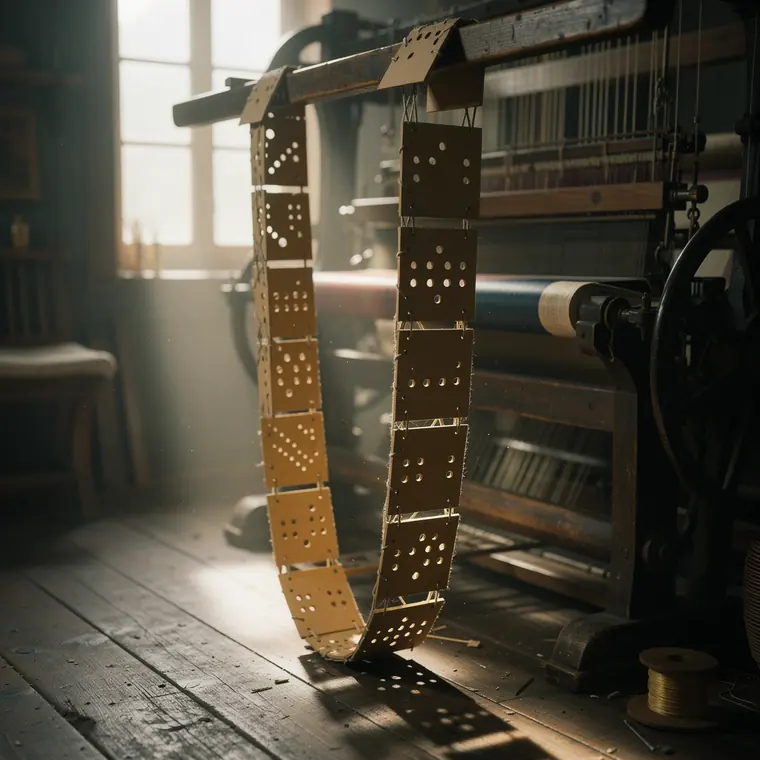
Rectangular pasteboard cards laced edge to edge with cord into a continuous belt, each card pierced with round holes in a different scattered pattern, the lacing threaded through small holes along the card edges, the chain hanging in a slack loop from the loom head down to the floorboards, the cards a buff brown against the dark timber of the loom, a weaver's workshop with daylight from a tall window on one side, the loom frame and harness cords behind the card chain softly blurred.
- What it was used for
- Falcon's card chain was the pattern store of a silk drawloom: punched cards laced together in an endless chain that ran over a four-sided prism. Jean-Baptiste Falcon worked as assistant to Basile Bouchon, who in 1725 had used a perforated paper band for the same purpose. The cards controlled the loom's rear harness: where there was a hole, a horizontal needle passed through; where there was none, it was pushed back. The card thus decided which warp threads were raised. What the workshop was relieved of was only the remembering of the pattern. The Science Museum records that "a draw boy was still required to present the cards to the assembly of horizontal wires." The drawboy stayed at the machine; he now pressed cards against the needles instead of pulling cords.
- What was new
- What was new was that the pattern broke into separate, exchangeable cards instead of one continuous band. Bouchon's paper band acted on a single row of needles (Bell 1895). Falcon instead laced cards into an endless chain and set his needles in several rows one above the other, so that more needles fitted into the same width (T. F. Bell, 1895). The Science Museum calls the loom "the first machine of any kind to be controlled by punch cards"; Alfred Barlow in 1878 gives the same sequence: Falcon "substituted a chain of cards" for the paper band, but the plan was not brought into practice until Jacquard took it up.
What the sources leave open: The dimensions and hole count of Falcon's cards, and the number of his needles, are not documented; Bell gives only four rows of needles for the Paris model. The date 1728 rests on a series of models shown by Professor Marin of Lyon at the 1855 Paris exhibition. The first name is disputed too: Grace's Guide points to a gallery label reading "Jean Philippe Falcon".
Connections
Every connection names its kind. “Forerunner” on its own would be a claim.
- Follows fromBouchon's Punched Tape1725Jean-Baptiste Falcon was Bouchon's assistant. In 1728 he replaced the perforated paper roll of 1725 with punched cards tied together in an endless chain. A draw boy was still needed to present the cards to the assembly of horizontal wires.Source: Science Museum Group: Model of Falcon's loom, 1728 · Mingei Project: Story of the Jacquard invention
Further reading
- Model of Falcon's loom, Science Museum Group Collection (Object 1963-379)
- T. F. Bell, Jacquard Weaving and Designing (London 1895), Kap. II, S. 18-19
- Alfred Barlow, The History and Principles of Weaving by Hand and by Power (London 1878), S. 140-141
- E. A. Posselt, The Jacquard Machine Analyzed and Explained (Philadelphia 1887), S. 7
- Jean-Baptiste Falcon, Grace's Guide to British Industrial History