Bouchon's Punched Tape
1725 · Perforated Paper Roll · Work 561 of 1,871
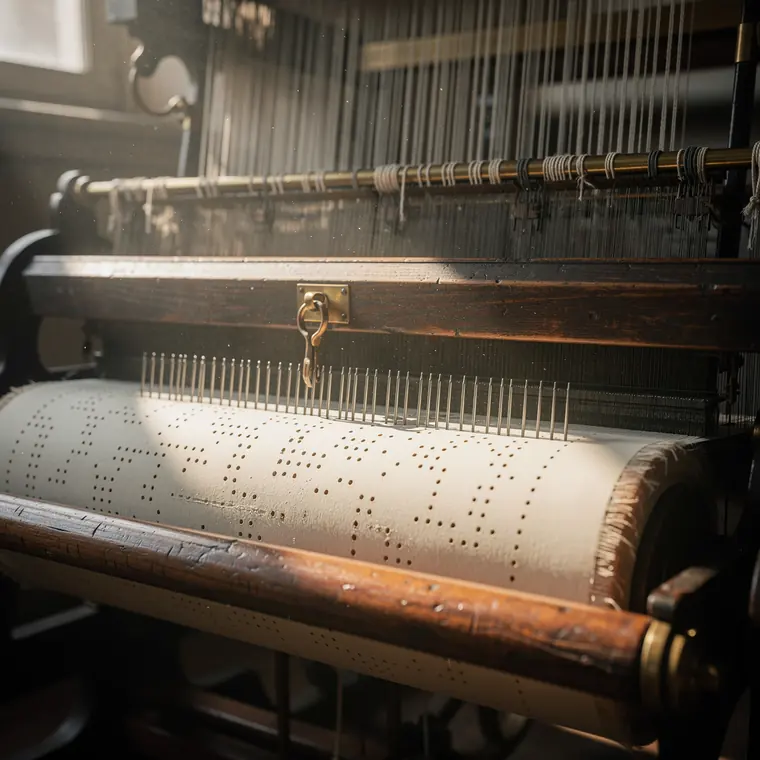
A roll of perforated paper drawn across a horizontal row of steel needles on a drawloom, the paper pressed against the needle ends by a hinged board, the needles meeting a hole passing through it and the others pushed back, the holes punched into the paper in an irregular scattered pattern, the paper a soft cream tone against dark iron and worn oak, the silk warp rising out of frame above, a weaver's workshop in Lyon with daylight falling from a single high window, the loom timbers and cords behind the paper roll dissolving into soft grey.
- What it was used for
- Basile Bouchon was a craftsman in Lyon, the son of an organ builder, who in 1725 wrote the pattern of a silk fabric onto a perforated paper tape. The draw boy pressed the tape with a hand-bar against a row of horizontal needles; where there was no hole the needle was pushed forward, where there was a hole it stayed in place — so the row of holes decided which leashes, and with them which warp threads, were raised. The pattern thus sat in a row of holes that could be kept and loaded again. On Bouchon's successor Falcon, the Science Museum in London records that his loom of 1728 was "the first machine of any kind to be controlled by punch cards, following Frenchman Basile Bouchon's use of perforated paper rolls in 1725" — Falcon replaced the continuous tape with cards tied into a chain.
- What was new
- What was new was that a working sequence sat in an interchangeable template rather than in a fixed barrel: a barrel organ plays what its cylinder dictates, whereas Bouchon's tape could be taken off and another put in. He did not invent control by holes out of nothing — he carried the principle of musical automata over to the loom. The barb: the pattern was stored, the labour was not abolished. On Falcon's loom of 1728 the Science Museum notes expressly that "A draw boy was still required to present the cards to the assembly of horizontal wires": a boy still had to press the template against the needles by hand. Seventy-nine years passed before Joseph Marie Jacquard refined the method in 1804 to the point where the draw boy was no longer needed.
What the sources leave open: No primary source on Bouchon himself was examined; the statements about 1725 come from the Science Museum's object record for Falcon's loom; the Computer History Museum article gives only the early 18th century. According to the Biographical Dictionary of the History of Technology, Bouchon seems to have had only one row of needles, which limited the width of the pattern; no source gives an exact number.
Further reading
- Model of Falcon's loom, 1728, Objekt co44927 (Science Museum Group Collection)
- Chris Garcia: Artifact Adopted! Preserving the Legend of J. M. Jacquard, 21. Dezember 2018 (Computer History Museum)
- Basile Bouchon (Grace's Guide to British Industrial History)
- Bouchon, Basile (Biographical Dictionary of the History of Technology)
- Basile Bouchon Begins the Automation of the Weaving Process (History of Information)
- Programming patterns: the story of the Jacquard loom (Science and Industry Museum)