The Card Reader
1836 · Jacquard Cards · Work 488 of 1,871
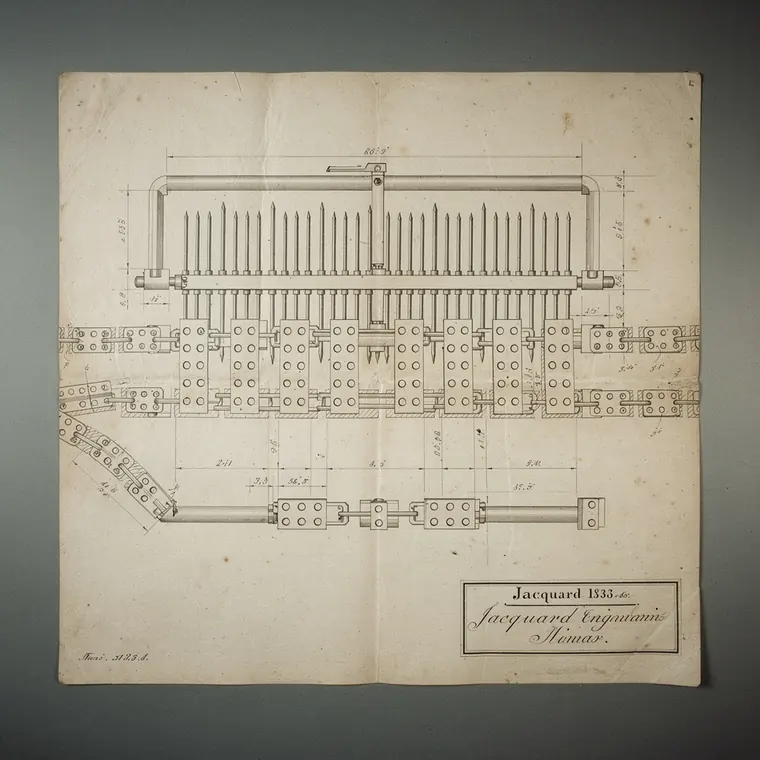
An engineering drawing of a card reading mechanism taken from the Jacquard loom, ink on cream paper, plan and elevation, a chain of stiff punched cards laced edge to edge shown running over a square prism, each card pierced with a grid of round holes, rows of blunt needles held above the cards on a hinged frame, ruled dimension lines, the title block a plain ruled box, the sheet laid flat on a grey studio table, even flat light from directly above.
- What it was used for
- The card apparatus of the Analytical Engine read the punched cards that told the machine what to do. Menabrea, to whom Babbage explained the design at Turin in 1840, distinguishes three kinds: operation cards, which set the mill to addition, subtraction, multiplication or division; variable cards, which state on which columns of the store the work is done; and number cards, which place a number directly on a column. The cards were strung together like the card chain of a Jacquard loom; holes let levers through, solid card blocked them. Each string had its own counting apparatus and could be moved forward and backward, independently of the other.
- What was new
- The punched card itself came from the loom. What was new was what it controlled here: in the earliest designs a studded barrel stood in its place, and Bromley writes that cards were substituted to overcome the evident inflexibility of the barrel. The program could now be of any length, and because the strings could run backwards, loops were possible. The sources checked here give no exact date for the introduction of the cards: the Science Museum's series of Analytical Engine drawings begins in September 1834 and ends on 6 March 1849, and Bromley describes the design as it stood in early 1838. No card apparatus was ever built; drawings are what remain.
Connections
Every connection names its kind. “Forerunner” on its own would be a claim.
- Follows fromThe Jacquard Head1804Babbage adopted the card mechanism from the Jacquard loom explicitly. Ada Lovelace put the connection in writing in 1843: the engine weaves algebraical patterns just as the Jacquard loom weaves flowers and leaves.
- Rediscovered inThe Drawings Catalogued1985The Analytical Engine had almost no influence on the computers of the 1940s. Its standing came later, when the drawings began to be read again from the 1970s onwards.
- Parallel toLudgate's Analytical Machine1909Ludgate's machine is likewise controlled by a perforated strip, which he called formula paper. He wrote that Babbage's writings assisted him only in the more advanced stages of the problem; Randell holds much of the work to be entirely original. Independent as far as the sources reach.Source: Computer Pioneers: Percy E. Ludgate (IEEE Computer Society) · Ludgate, Percy (Dictionary of Irish Biography, Royal Irish Academy)
- Works withThe Mill1837In 1842 Menabrea distinguishes two principal species of cards: those that fix the operations and those that fix the variables they act on. Ada Lovelace writes in Note B that the operation cards throw the mill successively into the state for each kind of arithmetic. The numbers themselves come from the store.Source: L. F. Menabrea, Sketch of the Analytical Engine (1842), übersetzt von Ada Lovelace 1843 (Classics in the History of Psychology, York University) · Ada Lovelace, Notes by the Translator, Note B (Classics in the History of Psychology, York University)
- Works withThe Store1837Menabrea, 1842: the numbers, "obeying the orders transmitted to the machine by means of the cards, pass alternately from the mill to the store and from the store to the mill".Source: L. F. Menabrea, Sketch of the Analytical Engine (1842), übersetzt von Ada Lovelace 1843 (Classics in the History of Psychology, York University)
Further reading
- L. F. Menabrea: Sketch of the Analytical Engine invented by Charles Babbage, trans. Ada Lovelace, Scientific Memoirs vol. 3 (1843), pp. 666-731
- Allan G. Bromley: Charles Babbage's Analytical Engine, 1838 (Annals of the History of Computing 4:3, 1982)
- Science Museum Group, The Babbage Papers: Drawings of the Analytical Engine (BAB/A)
- Science Museum Group: Babbage's Analytical Engine, 1834-1871 (Trial model), 1878-3