The Store
1837 · Memory Columns · Work 490 of 1,871
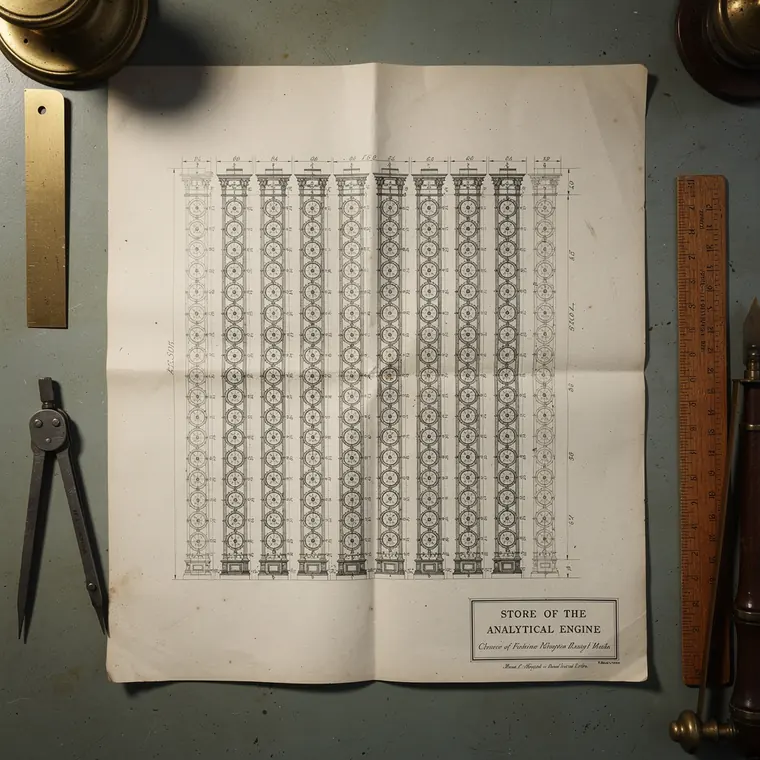
An elevation drawing of the store of the Analytical Engine, ink on cream paper, fifty identical vertical columns standing side by side, each column a stack of forty numbered wheels one above the other, the columns repeating in strict rhythm across the whole width of the sheet, ruled dimension lines, the title block a plain ruled box, the sheet laid flat on a grey studio table, even flat light from directly above.
- What it was used for
- The store held the numbers between operations. Figure wheels sat on vertical axes, one wheel per digit, 40 digits plus a sign wheel in a 41st cage; the space between two plates is what Babbage calls a cage, the bottom one carrying the units, the next the tens, then the hundreds. If the digit on the sign wheel is even the number is taken as positive, otherwise as negative. From the layout of the variable cards Bromley infers 50 axes, each with two sets of figure wheels, hence 100 numbers. Menabrea, describing the state of the design in 1840, assumes forty discs per column; in her notes of 1843 Lovelace puts the number of columns at probably at least two hundred.
- What was new
- What was new was a number store separated from the arithmetic unit and addressable item by item through cards. Bromley puts a price on it: the Analytical Engine would have been about the size and weight of a small railway locomotive. For Bromley's 100 numbers of 40 digits plus sign that means over 4,000 figure wheels, for a memory that today fits in under two kilobytes. That the figures for its size differ is not a contradiction between sources but a difference between two estimates: Bromley infers his figure for 1838 from the layout of the variable cards, Lovelace writes 'probably' in 1843. No store was built; by Babbage's death in 1871 only a trial piece, part of the mill with printing mechanism, had been completed.