The Drawings Catalogued
1985 · Reconstruction Project · Work 514 of 1,871
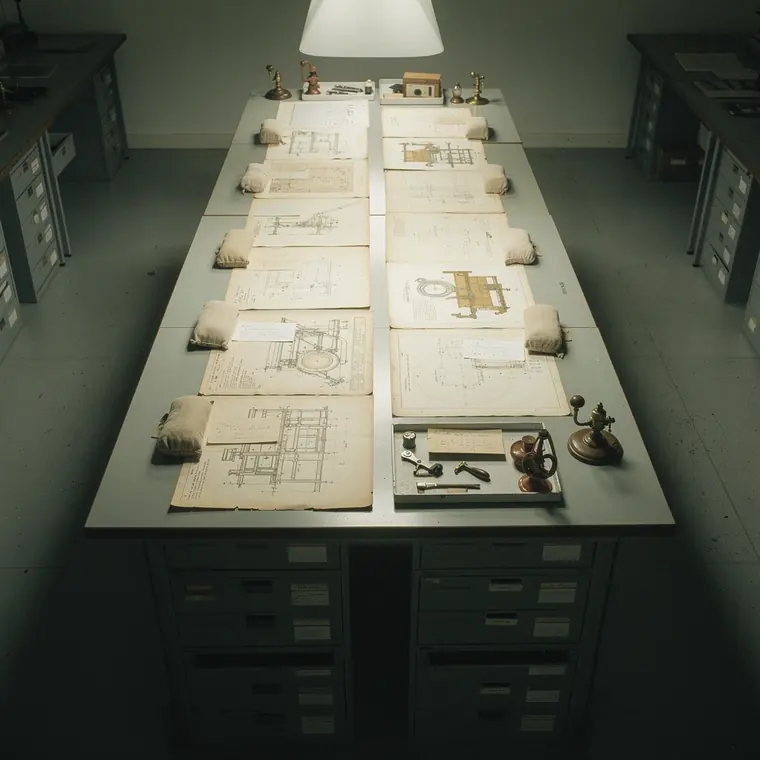
A long table in a museum store covered end to end with nineteenth century engineering drawings, each sheet weighted flat with cloth-covered weights, small plain paper slips laid across them, grey archive boxes stacked beneath the table, the paper cream against the grey, the table top plain grey, the drawings of several sizes overlapping at their edges, the table seen from directly above, even flat light from above.
- What it was used for
- Charles Babbage's technical papers are held in the Science Museum library in London; the Science Museum Group gives the extent as eleven plan press drawers and eight linear metres of shelving, covering 1821 to 1905. Doron Swade, then curator of computing, describes what was found there: crucial sheets undated, comments and diagrams cryptic and fragmentary, complex mechanisms depicted on large engineering drawings, few of which have any written explanation. Allan Bromley of the Basser department of computer science at Sydney University had, on Swade's account, been visiting London for a few months each year since 1979 to study them. The proposal Bromley had addressed to the museum's director is dated 20 May 1985: that the museum should build a Babbage engine to the original designs, to be completed by 26 December 1991, the two hundredth anniversary of Babbage's birth.
- What was new
- What Bromley's list could do that the one of 1889 could not follows from two sentences of the Science Museum Group on the same page: Henry Prevost Babbage had in 1889 listed only the main series of drawings and notations in "Babbage's Calculating Engines"; Bromley's published finding aid identifies all of the individual items in the archive and establishes a uniform system of identification. It appeared in 1991 — so the library catalogue of the Museum of the History of Science in Oxford and Swade himself, who calls it the first near-comprehensive record. Near: Swade wrote in 2019 that material had evaded the museum's scanning operation in 2011 largely because it was not listed in Bromley's catalogue.
Further reading
- Doron Swade, The building of a time machine, Times Higher Education, 14.01.2000
- Science Museum Group, Archivbeschreibung The Babbage Papers (Ref. BAB)
- Museum of the History of Science, Oxford, Bibliothekskatalog: Allan Bromley, The Babbage Papers in the Science Museum Library: A Cross-Referenced List, Science Museum, London 1991
- Doron Swade, Analytical Engine, Resurrection Nr. 86, Computer Conservation Society, Sommer 2019
- Computer History Museum, A Modern Sequel (Babbage-Projekt)