The Mill
1837 · Arithmetic Unit · Work 489 of 1,871
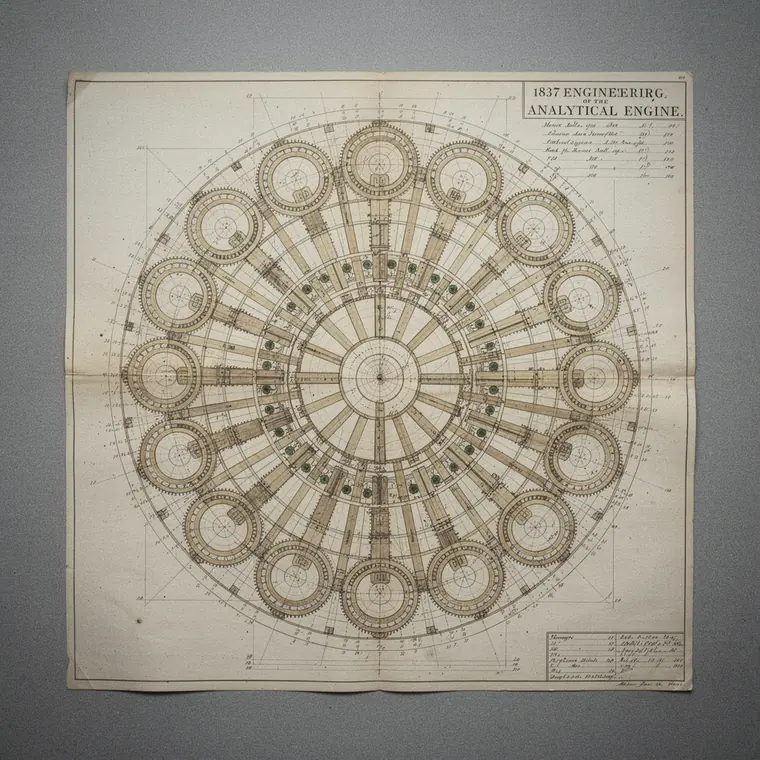
An engineering drawing of the mill of the Analytical Engine, ink on cream paper, the plan a great circular arrangement of gear columns around a central axis, the columns set radially like the spokes of a rose window, each column drawn as a ring of concentric circles, ruled dimension lines, the title block a plain ruled box, the sheet laid flat on a grey studio table, even flat light from directly above.
- What it was used for
- The mill was the arithmetic unit of the Analytical Engine. Numbers were brought to it from the store, added, subtracted, multiplied or divided there, and written back. For the design as it stood in early 1838 Bromley describes head and tail axes as accumulators, nine table axes for multiplication and division, and three sets of carry apparatus. Arithmetic was decimal, all 40 digits at once. A simple number transfer took about 2.4 seconds and a full addition about 3 seconds. Bromley puts a division at about four minutes and the multiplication of two 40-digit numbers at about four minutes in the worst case, about two being more typical.
- What was new
- What was new was the separation: Bromley records that, in marked contrast to the Difference Engine, the Analytical Engine draws a clear distinction between the store, where numbers lie between operations, and the mill, where arithmetic is done. The barb is in the reason for it. It was mechanical: the carry mechanism was relatively complex, and that, according to Bromley, was the initial incentive to separate store and mill and concentrate the arithmetic in one place. A problem of gears produced a layout that Bromley likens to the memory and CPU of a modern computer; in his view it did not influence them, because Babbage's papers were not examined in detail until 1969.