Hollerith's Tabulator
1890 · Electric Tabulating Machine · Work 567 of 1,871
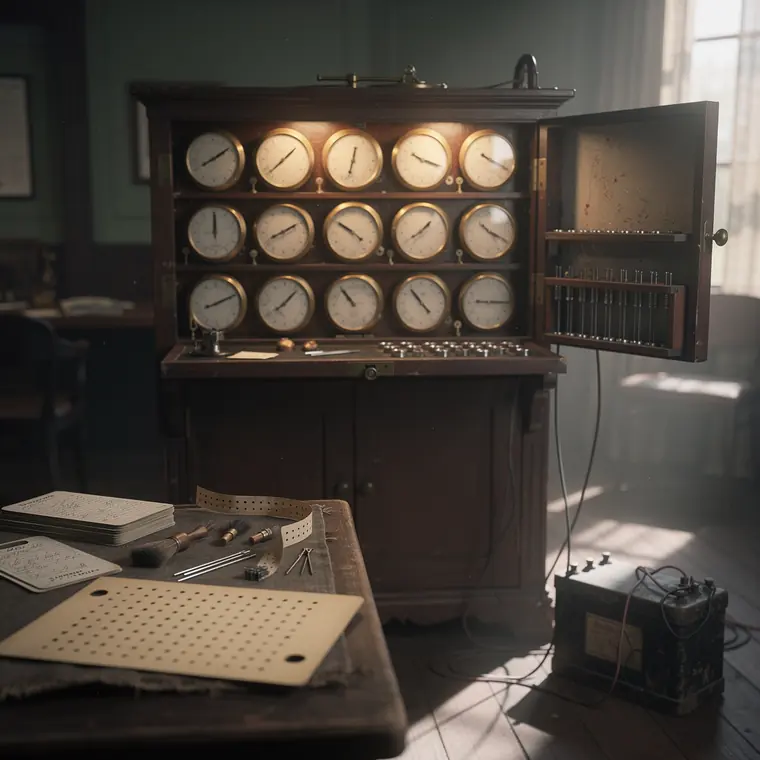
A tall wooden cabinet carrying a panel of forty round counter dials in rows, each dial with two hands and a plain face in a brass bezel, a hinged press at the right where a single card is laid over a bed of mercury cups, spring pins in the upper jaw descending through the holes to the mercury beneath, wires running down to a battery on the floor, the card in the press close to the lens, a plain buff card punched with round holes in a scattered pattern, the rows of dials behind it dissolving into soft focus, the cabinet in dark oak, a census office in Washington lit by tall windows.
The 1880 census had taken eight years to tabulate; the 1890 census was done in a little over two. For the first time an administrative task was solvable only because a machine took it on. The company that grew out of it became IBM.
- What it was used for
- For the 1890 United States census - age, sex, origin, occupation and infirmity of 62 million people. Afterwards for insurers, railways and statistical offices across Europe.
- What was new
- Not the counting but the SORTING by any chosen field without going through the pile again. Hollerith won the Census Office's trial against two rival methods; what decided it was not counting speed but that the same cards could be interrogated again and again in different ways.
Connections
Every connection names its kind. “Forerunner” on its own would be a claim.
- Follows fromThe Jacquard Head1804The punched card as a carrier of machine-readable facts comes from weaving.
- Made possibleThe Social Security Account1936The 1936 social security account could not have been maintained without machine card processing - the same technique, thirty years on, applied to every working person.
- Parallel toThe Card Reader1836Both have a machine feel for holes in cards. ETHW records, though, that Hollerith had no knowledge of Babbage's work, and his own account of the invention does not mention the Jacquard card. Babbage's cards later served as prior art against Hollerith's patents.Source: Early Punched Card Equipment, 1880-1951 (Engineering and Technology History Wiki, IEEE) · Douglas W. Jones, Punched Cards: A brief illustrated technical history (University of Iowa)
- Made possibleThe Railway Waybill1935In September 1896 Hollerith signed a contract with the New York Central to supply punched card equipment to audit up to four million waybills in the following year. In April 1904 the railroad's operators punched 428,502 cards.Source: Early Punched Card Equipment, 1880-1951 (Engineering and Technology History Wiki, IEEE) · From Herman Hollerith to IBM (National Museum of American History, Smithsonian)
- Works withThe Hollerith Card1890Card and tabulator were designed for each other: where the card has a hole, a spring-loaded pin of the press passes through into a small cup of mercury, closes a circuit and advances a counter dial by one. This is how the Computer History Museum describes it.Source: Making Sense of the Census (Computer History Museum)
- EncounteredFerris Wheel Chicago1893World's Columbian Exposition, Chicago 1893: the machine stood in the Census exhibit, where clerks tabulated 1890 census data in front of the crowds; the popular display earned Hollerith a bronze medal. At the same fair the wheel was the centrepiece of the Midway Plaisance, opened 21 June.Source: U.S. Department of Commerce Research Library: Championing Commerce at the World's Fair · Chicago History Museum: A Wheel With A View
- EncounteredYerkes Refractor1897World's Columbian Exposition, Chicago, 1893. According to the U.S. Commerce library the Census Bureau showed the electric tabulating machine there, clerks tabulated 1890 census data in front of the crowds, and Hollerith took a bronze medal. At the same fair stood the still lensless tube of the 40-inch Yerkes refractor.Source: U.S. Department of Commerce Research Library: Championing Commerce at the World's Fair (Census-Ausstellung, Hollerith, Bronzemedaille) · Linda Hall Library, Scientist of the Day: Alvan Graham Clark (Rohr des 40-Zoll-Refraktors auf der Weltausstellung 1893) · The Franklin Institute, Case Files: Herman Hollerith ('the 1893 Bronze Medal of the World's Fair')
- Works withThe Sorting Box1890Sorter and tabulator are electrically coupled: according to the Smithsonian, the brass cover of each of the 26 compartments is held by an electric catch connected to the tabulator, and a cable runs from the box to the machine. Once a card has been read, a compartment springs open and the card is placed in it by hand.Source: From Herman Hollerith to IBM (National Museum of American History, Smithsonian) · Case Files: Herman Hollerith (The Franklin Institute)
- Works withThe Pantograph Punch1890The Smithsonian lists in Hollerith's system a punch for entering data about each person onto a blank card, the tabulator for reading the cards and summing up information, and the sorting box. The punch was the pantograph punch used in the 1890 census, its plate marked with the system's name. The punched cards were then fed into the tabulator.Source: From Herman Hollerith to IBM (National Museum of American History, Smithsonian) · Hollerith 1890 Census Tabulator (Columbia University Computing History)