The Railway Waybill
1935 · Freight Accounting · Work 591 of 1,871
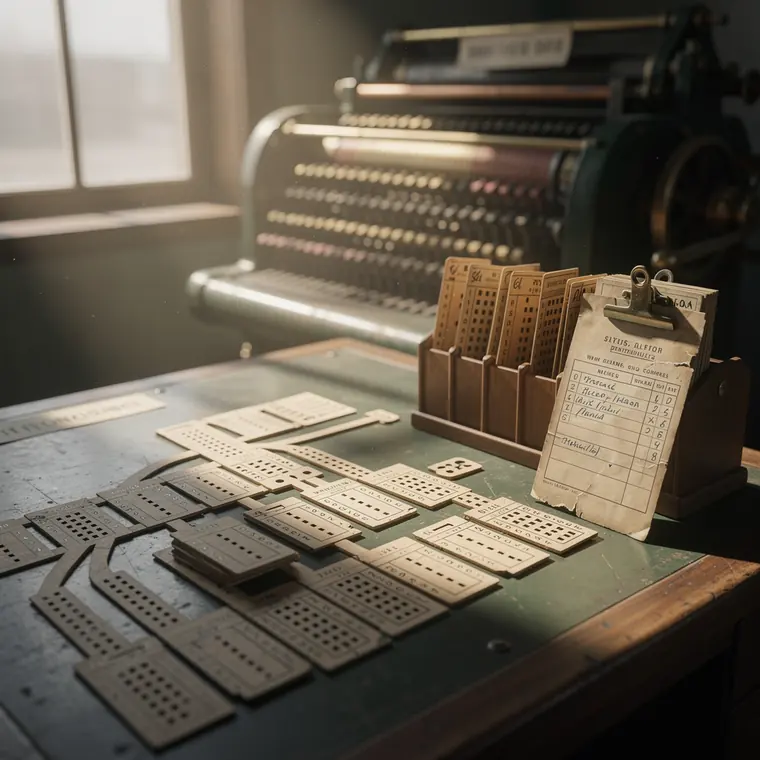
Punched cards standing in a rack divided by plain tabs, a printed waybill clipped beside them with its ruled boxes and small headings, a sorting table with cards laid out in the shape of a branching network of lines, cards with one corner cut ruled into columns with the digits 0 to 9 printed down each column and rectangular holes punched in a scattered pattern, the laid-out cards close to the lens, the rack and the office behind in soft focus, a railway freight office lit by daylight from a tall window.
- What it was used for
- The waybill was the document by which a railroad accounted for its freight shipments, and from the 1920s that accounting moved out of the stations into central bureaus. A. J. Moran described at the 1930 annual convention of the Railway Accounting Officers Association how this had worked on his line for the past seven years: waybills were first revised as to rates and extensions and then sent to the bureau. There a card was punched for each waybill, showing waybill reference, freight bill number, freight and advances in one amount, and the amount prepaid. From those cards a tabulating printer produced the daily freight received report for the general office. Items once paid were withdrawn from the open file, and a gang punch punched the date of payment into each card.
- What was new
- What was new was not the arithmetic but the move: accounting left the station. The survey Moran reported shows how far this had gone by 1930. A questionnaire went to 38 of the large carriers in North America; 20 were operating under zone and bureau plans, and of those 16 did the work with punched cards and tabulating machines, 4 with other mechanical devices. Moran also named the limit: in his opinion the punched-card plan was not economical unless a minimum of 40,000 items could be assembled in one bureau. The barb is in his own paper: roads that did not use the card plan argued that an agent compelled to build up his station's debits and credits gives more personal attention to outstanding items. Moran replied that the agent's responsibility is neither greater nor less either way.
What the sources leave open: The documentable railway literature on punched cards clusters between 1929 and 1933; nothing relevant for 1935 was found in Railway Age. No annual card or waybill volumes for a named railroad in the 1930s were found; the volume figures that do exist concern car accounting, not waybill accounting.