The Social Security Account
1936 · National Record · Work 590 of 1,871
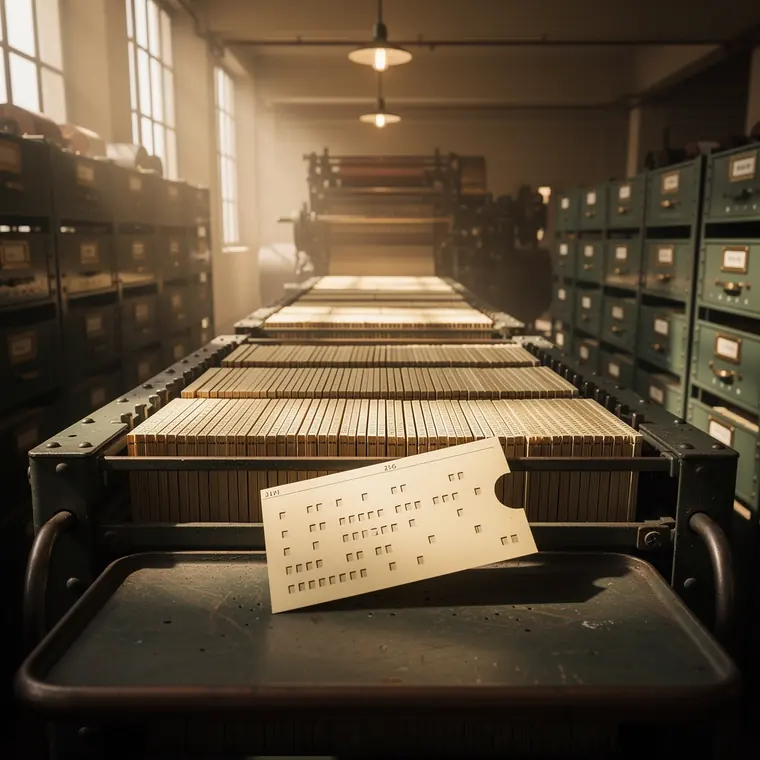
A vast filing installation of card trays in steel racks running the length of a hall, each tray one block of records, a single stiff buff punched card lying on a trolley in the foreground, one corner cut, rectangular holes in a scattered pattern across plain unprinted card stock, the card and the nearest tray close to the lens, the racks receding into soft focus along the hall, tall windows on one side, pendant lamps along the ceiling, the cards buff against grey steel.
- What it was used for
- The Social Security account was the record on which an American worker's reported wages accumulated over a working life. It grew out of the reporting duty that began in January 1937. Social Security's own account states that this required numbers to be assigned to 26 million workers and 3.5 million Employer Identification Numbers. Because its own staff was too small, the Board signed an agreement with the Post Office Department on 25 September 1936: postmasters compiled lists of employers, post offices distributed and collected the application forms, and 1,017 first-class post offices assigned the numbers and typed the cards. About 35 million numbers were issued in the first eight months of the drive.
- What was new
- What was new was one account per person, carried through a working life and merged by machine with employers' reports. IBM built a machine for it: Social Security writes that the new IBM machines Secretary Frances Perkins had in mind were principally the IBM 077 collator, developed by IBM expressly for the programme and deployed to this task in early 1937. Carolyn Puckett records in the agency's own bulletin that the number was created in 1936 for the sole purpose of tracking earnings histories, and that the card was never intended to serve as a personal identification document. The barb was physical: the paper file grew too heavy for buildings in Washington, and Social Security moved with its records into a former Coca-Cola factory in Baltimore. Occupation began in October 1936; 18 production workers in November 1936 became over 2,500 by the end of December, and about 5,300 when the agency left in January 1960. The Visible Index took up 24,000 square feet of floor space.
Connections
Every connection names its kind. “Forerunner” on its own would be a claim.
- Follows fromHollerith's Tabulator1890The same card technology, thirty years later, moving from counting to continuous record-keeping.
- Made possibleThe Collator Type 0771937IBM developed the Type 077 collator specifically for the Social Security agency: cards arrived from all over the country and had to be brought together onto one account. H. J. MacDonald, who led the sales campaign, on the machine: without it "we would have been lost".Source: The IBM 077 Collator (IBM, history pages) · Social Security History: The Machines That Ran the Program (SSA Historian's Office, Cronin)
Further reading
- Social Security Administration, Historian's Office, Research Note #6: Early Automation Challenges for SSA (Larry DeWitt, April 2000)
- Social Security Administration, The Candler Building: Home to Social Security 1936-1960
- Carolyn Puckett, The Story of the Social Security Number, Social Security Bulletin, Vol. 69, No. 2 (2009)