The Sorting Box
1890 · Electric Sorter · Work 570 of 1,871
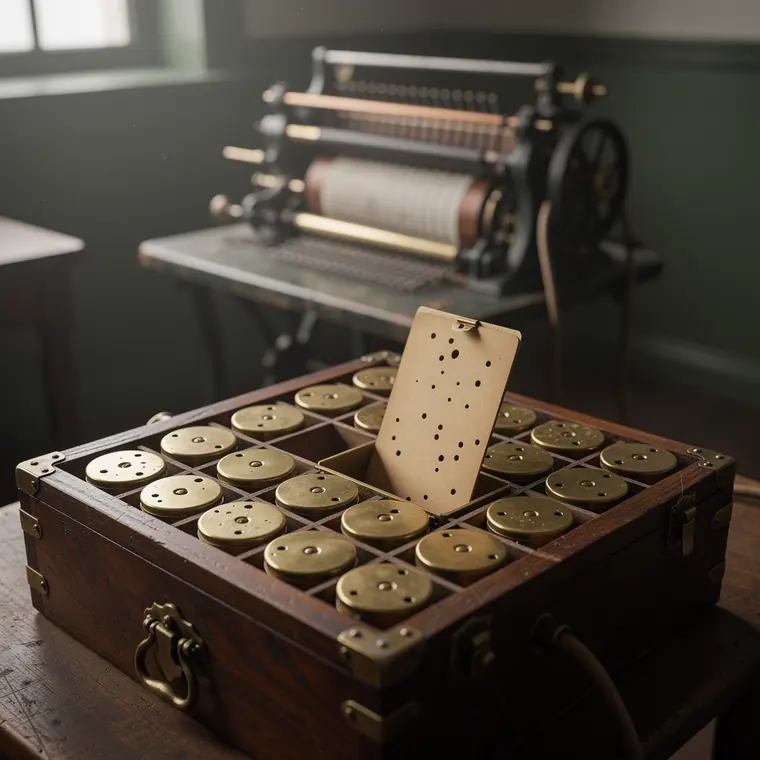
An oak sorting box of twenty-six lidded compartments arranged in two rows, one brass lid sprung open by its electric catch with a single buff card lying in it, the other lids shut flat, a cord running from the box to the tabulator standing alongside, the card a plain buff pierced with round holes in a scattered pattern, the open lid and the card close to the lens, the box in dark oak with brass fittings, a census office lit by tall windows, the tabulator and its dials behind the box in soft focus.
- What it was used for
- The sorting box stood at the tabulator and set the counted cards aside ready for the next pass. It was a box divided into compartments, each closed by a spring-loaded lid held shut by a catch in an electromagnet's armature. When the press closed the circuit, the magnet pulled its armature down, the lid sprang up and stayed open. Nothing was transported: the operator took the card out of the press, placed it in the open compartment with her right hand, patted the lid down, and with her left hand already brought the next card under the press. Martin wrote in 1891: "It is done much more quickly than it is described." The Smithsonian's 1890 example has 26 compartments in two rows.
- What was new
- What was new was that sorting ran in the same movement as counting. Truesdell calls the box explicitly a supplementary device, "designed primarily as a supplement to tabulation"; its wiring could be set to the characteristics needed for the next pass, including those requiring two or more columns together. The limit was the hand: every card had to be placed individually, and there were fewer compartments than counters. The Census Office got an automatic sorting machine only at the next census. Towards the end of the 1900 census period the Hollerith company had twenty built for the very numerous crop cards, which Truesdell calls "rather crudely made" and in frequent need of repair. The Type 70 Vertical Sorter followed in 1908.
What the sources leave open: The figure 26 comes from the Smithsonian and from Donald Knuth; IBM gives 24. The primary sources - Hollerith 1889, Martin 1891, Truesdell 1965 - give no number at all, only "numerous compartments" and the statement that there were fewer compartments than counters. Whether all the boxes used in 1890 had the same number of compartments is not documented.
Further reading
- Hollerith Card Sorter, Smithsonian National Museum of American History, Objekt nmah_694412 (26 Fächer, 1890)
- Herman Hollerith, An Electric Tabulating System (1889), Beschreibung der Sortierbox (Fig. 7)
- Léon E. Truesdell, The Development of Punch Card Tabulation in the Bureau of the Census 1890-1940 (US GPO 1965), S. 86-87
- IBM Sorters, Columbia University Computing History (Typenliste, Type 70 Vertical Sorter 1908)