The Pantograph Punch
1890 · Card Punching · Work 568 of 1,871
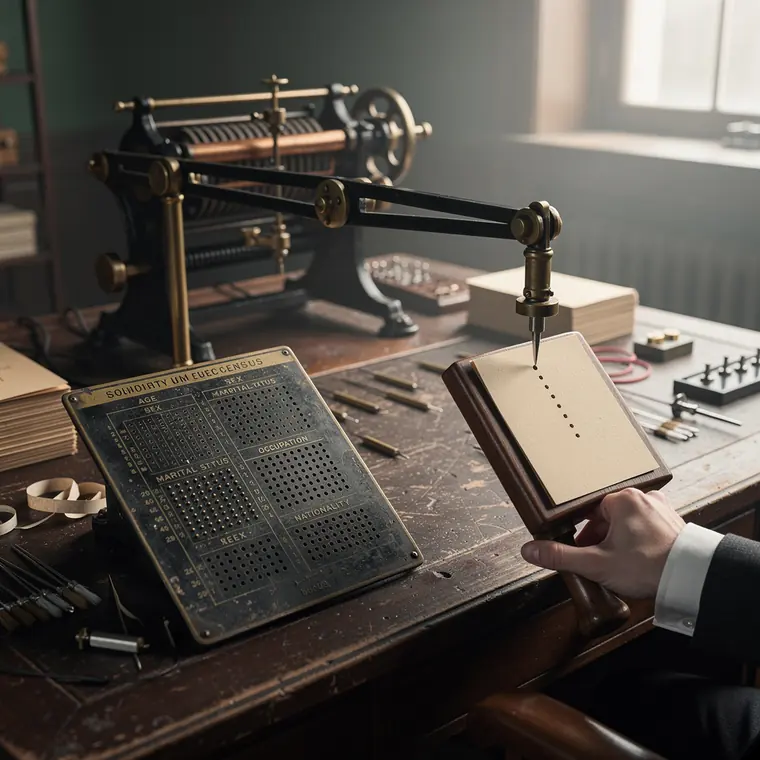
A pantograph card-perforating instrument on a desk, a flat template plate on the left pierced with a grid of small holes in ruled groups, a card holder on the right holding a plain buff card, a long pivoted arm linking the two so that a pointer placed in a template hole makes a round perforation in the card at the matching position, the tool in black iron with brass fittings, the card and the template close to the lens, a clerk's hand on its wooden handle, the desk in a census office under daylight from a window, the room behind the instrument out of focus.
- What it was used for
- The pantograph punch was the machine by which the entries on the census schedules became punched cards. It was about the size of a typewriter tray. At the front lay a celluloid punch board with twelve rows of twenty holes, each marked with an abbreviation for one question and its answer; above it an index finger swung freely. When the operator pressed the pointer into one of these holes, the punch at the rear - on the pantograph principle - stamped the corresponding hole in the manila card. For checking there was a reading board the size of the card, on which the abbreviation showed through wherever a hole had been punched. According to Martin in 1891, "a large part of the punching ... [was] done by women clerks".
- What was new
- What was new was that punching hundreds of cards a day was physically sustainable. In the Baltimore trial Hollerith had still punched the holes with an ordinary ticket punch; according to the IEEE wiki his hand and arm were afterwards "nearly paralyzed". The pantograph translated large hand movements into small punch travel and at the same time showed, on the enlarged diagram, where the hole belonged. The Census Office budgeted 500 cards per clerk per day; the actual average became 700, and Martin reports expert punchers who between 9 a.m. and 4 p.m. did 1,100 cards with 18,700 holes in all. The improvement spoiled the office's own arithmetic in the right direction: because the saving had been estimated on 500 cards, it came out 40 per cent higher than expected.
What the sources leave open: No explicit statement by Hollerith on why he built a pantograph rather than a typewriter keyboard was found; on the contrary, Martin in 1891 draws the keyboard comparison approvingly. The number of punches in use in 1890 is not documented. The card's geographic identification was not punched with the pantograph but with a second machine, the gang punch, in three to six cards at a time.
Connections
Every connection names its kind. “Forerunner” on its own would be a claim.
- Works withThe Hollerith Card1890The punch carries a template marked with the categories of the 1890 census, with a holder for the card behind it. An arm pivoted at the back puts one point into a hole in the template while the other punches the matching hole in the card. The template is lettered "The Tabulating Machine Company".Source: Smithsonian National Museum of American History: Hollerith Pantograph Card Punch
Further reading
- T. C. Martin, Counting a Nation by Electricity, The Electrical Engineer, 11. November 1891, S. 522-530
- Léon E. Truesdell, The Development of Punch Card Tabulation in the Bureau of the Census 1890-1940 (US GPO 1965), S. 43, 47-48
- Emerson W. Pugh, Early Punched Card Equipment 1880-1951, IEEE Engineering and Technology History Wiki
- Hollerith Pantograph Card Punch, Smithsonian National Museum of American History, Objekt nmah_694411