Yerkes Refractor
1897 · Refracting Telescope · Work 203 of 1,871
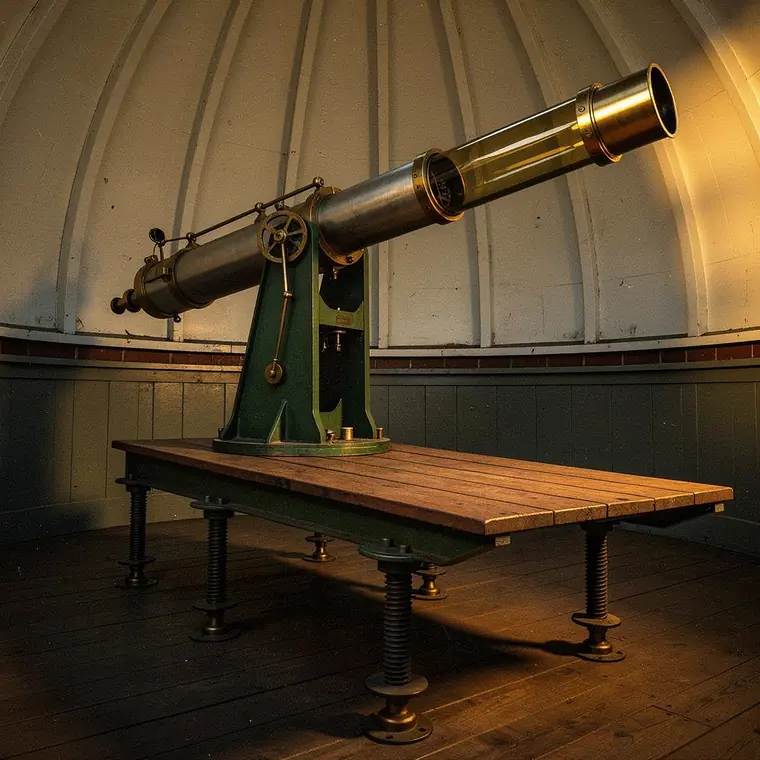
The forty inch Yerkes refractor in its Williams Bay dome, long steel tube on an equatorial mount above a rising wooden observing floor raised on screw jacks.
- What it was used for
- The refractor is the main instrument of Yerkes Observatory at Williams Bay, Wisconsin, which the University of Chicago dedicated on 21 October 1897. University astronomers used it; Frank Schlesinger, for example, measured stellar parallaxes with it, that is, the distances of nearby stars. The glass was not meant for Chicago: the University of Southern California had ordered a 40-inch telescope from Alvan Clark and Sons, with $50,000 promised by the banker E. F. Spence. When the Southern California economy slumped, the project fell apart; the glass had already been ordered. George Ellery Hale brought it to Chicago and won over the streetcar magnate Charles T. Yerkes as funder. The tube was already on show at the 1893 World's Fair in Chicago.
- What was new
- The lens by Alvan Clark and Sons measures 40 inches (102 cm). According to the University of Wisconsin, it gathers about 25 percent more light than the 36-inch refractor at Lick Observatory, the largest until then. It is still regarded as the world's largest refractor; only the showpiece lens of the 1900 Paris Exposition was bigger, at 1.25 m, and it was dismantled afterwards. With it, the line of great lens telescopes also came to an end. According to Mount Wilson Observatory, a larger lens would have sagged under its own weight or absorbed too much light. Hale himself was already betting on mirrors: his father had bought the blank for a 60-inch mirror before the dedication. That telescope went into service on Mount Wilson in 1908.
Connections
Every connection names its kind. “Forerunner” on its own would be a claim.
- EncounteredHollerith's Tabulator1890World's Columbian Exposition, Chicago, 1893. The Linda Hall Library: "In 1893, the tube for the 40-inch Yerkes telescope was displayed at the World's Columbian Exposition in Chicago, while it was awaiting its lenses." In the Census exhibit clerks demonstrated Hollerith's electric tabulating machine on 1890 data; he took a bronze medal from the fair.Source: Linda Hall Library, Scientist of the Day: Alvan Graham Clark (Rohr des 40-Zoll-Refraktors auf der Weltausstellung 1893) · U.S. Department of Commerce Research Library: Championing Commerce at the World's Fair (Census-Ausstellung, Hollerith, Bronzemedaille) · Yerkes Observatory: Legacy (Zeitleiste 1893, Rohr des Great Refractor auf der Ausstellung)
Further reading
- Mount Wilson Observatory: Building the 60-inch Telescope
- Mount Wilson Observatory: Bringing Astronomy to an Isolated Mountaintop
- Yerkes Observatory: Legacy
- Linda Hall Library: Scientist of the Day – Charles Yerkes
- University of Wisconsin, Wisconsin 101 (Archivfassung, Seite abgeschaltet): Yerkes Telescope Construction and Use
- Astronomy Magazine: Oct. 21, 1897: Yerkes Observatory is dedicated
- ESA: The Yerkes 40 inch refractor telescope – 1897
- Paul Schlyter: Largest optical telescopes of the world