Cotton Gin
1793 · Cotton Gin · Work 290 of 1,871
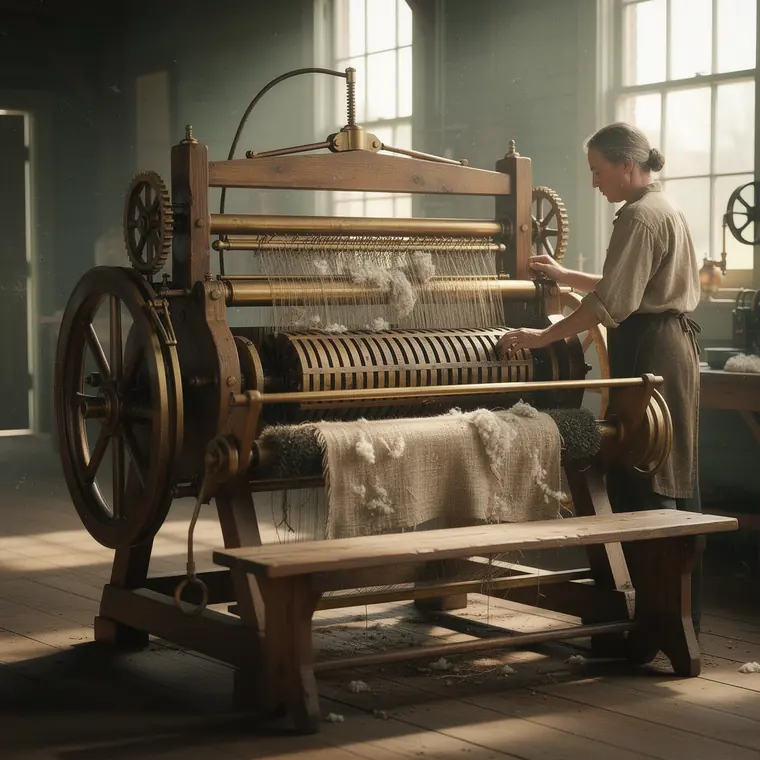
Eli Whitney's cotton gin on a plantation yard bench, wire hooks on the rotating drum pulling lint through a slotted grate while a brush roller sweeps fibre clear of seeds.
- What it was used for
- Eli Whitney built the machine at Mulberry Grove near Savannah, the plantation of Catharine Greene, widow of Nathanael Greene; Greene's plantation manager and later husband Phineas Miller became his business partner. The machines were not to be sold: Miller and Whitney meant to erect them throughout the cotton district and engross the ginning business themselves - which Olmsted in 1846 called "evidently an unfortunate scheme". The task was short-staple upland cotton, on which roller gins failed. Whitney to Jefferson, 24 November 1793: the cylinder two feet two inches long and six inches in diameter, turned by hand, and "it is the stated task of one negro to clean fifty weight ... of the green seed cotton per day". The comparison figure of one pound a day by hand is Olmsted's: a day's work for a woman. The petition was filed on 20 June 1793, the patent granted on 14 March 1794.
- What was new
- It was not the first gin: single-roller gins go back to the fifth century, and the Indian churka, a double-roller gin, averaged about 2.3 kilograms of fibre a day according to a 2020 study in the Journal of Cotton Science, five times the single-roller gin; Joseph Eve of Augusta patented an improved roller gin in 1788, and a similar device is credited to Krebs of Mississippi in 1772. Whitney's novelty was a change of principle from pinching to pulling: wire teeth on a rotating cylinder engaged the fibres and pulled them through narrow slots in an iron bar, with a brush stripping them off. He was quickly overtaken: Hodgen Holmes's saw gin, patented on 12 May 1796, replaced spikes with circular saws and allowed continuous operation; who invented the saws the New Georgia Encyclopedia calls "foggy". Whether Catharine Greene contributed technically is documented in none of the sources checked - nor is it disproved.
Further reading
- Denison Olmsted, Memoir of Eli Whitney, Esq., 1846 (Petition 20.6.1793; Brief an Jefferson 24.11.1793; Geschäftsmodell; Erträge)
- US National Archives, Milestone Documents: Patent for Cotton Gin (14. März 1794)
- Hughs, Holt, Armijo, Whitelock, Valco: Development of the Cotton Gin, Journal of Cotton Science 24 (2020), S. 34-43
- New Georgia Encyclopedia: Cotton Gins
- Ariel Ron: How Eli Whitney Single-handedly Started the Civil War ... and Why That's Not True, Commonplace, Oktober 2025
- New Georgia Encyclopedia: Cotton Gins (Krebs 1772, Eve 1788)