Girard Flax Frame
1810 · Wet Spinning of Flax · Work 291 of 1,871
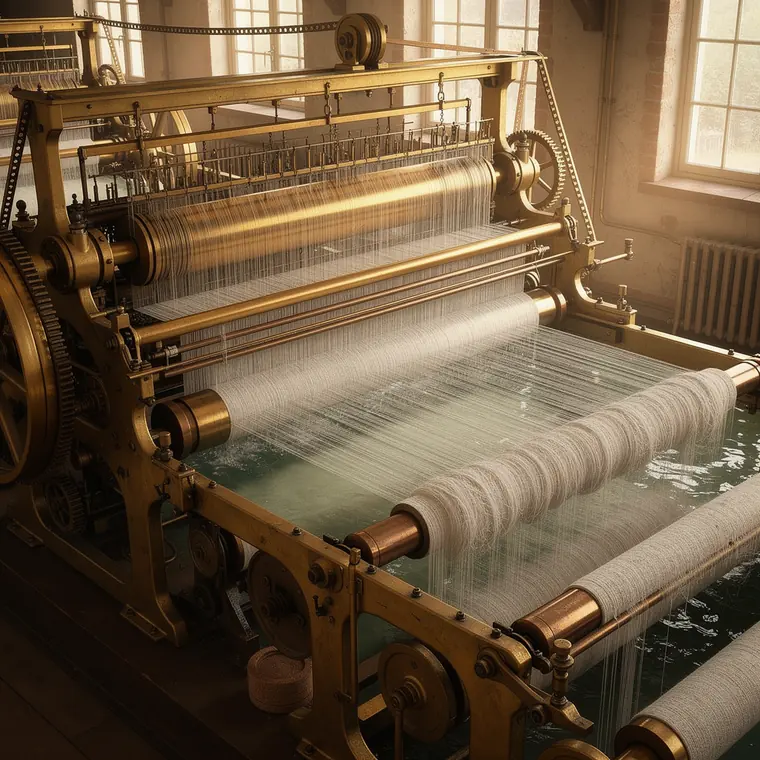
Philippe de Girard's wet flax spinning frame in a French mill, rovings passing through a trough of heated water before reaching the drawing rollers and the filling bobbins.
- What it was used for
- The machine was wanted for spinning fine flax yarn for linen, in a market that cotton was displacing. The works that lasted were not in France - the Paris establishment of 1813 ended, by the Universalis, in ruin: in 1815 Philippe de Girard went, at the invitation of the Austrian government, to Hirtenberg near Vienna, where he set up a factory for spinning machinery - the 1911 Encyclopaedia Britannica writes that the Hirtenberg concern "failed to prove a commercial success" -, and to Pottendorf, where a spinning mill was built. In 1825 he was engaged as chief mechanic in the Kingdom of Poland; the founding deed of the flax mill was drawn up on 9 August 1830, production began on 24 July 1833 at the former Ruda Guzowska, and the settlement was renamed Żyrardów in his honour. The linen museum there carries his name. He never received the advertised million - the empire that had promised it had fallen first.
- What was new
- In the spring of 1810 Le Moniteur published Napoleon's competition with a prize of one million francs; by the Encyclopédie Universalis, Girard filed a first patent in July 1810, which according to the 1911 Britannica covered methods for both dry and wet spinning. He was not the first patentee of flax spinning machinery: John Kendrew and Thomas Porthouse of Darlington held a patent as early as 1787, and John Marshall at Leeds span flax dry from 1793, but only in the coarser counts up to No. 16 (Dwight C. Long, Journal of Economic History, 1954). The difference of the wet method: the rove passes through a trough of water heated to about 120 degrees Fahrenheit, which softens the gum between the elementary cells so that they can be drawn out without breaking the fibre; here the Universalis describes an alkaline solution rather than plain water. Who first made wet spinning commercially workable is unsettled; a prototype is also dated to 1817.
Further reading
- Linen and Linen Manufactures, Encyclopaedia Britannica, 11. Auflage 1911 (Preis 1810; Nass- und Trockenspinnen; 120 Grad Fahrenheit; Kendrew und Porthouse 1787; Hirtenberg 1815)
- Dwight C. Long: Philippe de Girard and the Introduction of Mechanical Flax Spinning in Austria, Journal of Economic History 14 (1954)
- Encyclopédie Universalis: Machine à filer le lin de Girard
- ERIH: Biografie Philippe de Girard (1775–1845)
- Muzeum Historii Polski: Powstanie Żyrardowa
- Muzeum Lniarstwa im. Filipa de Girarda, Żyrardów: O muzeum