Thorp Ring Frame
1828 · Ring Spinning Frame · Work 293 of 1,871
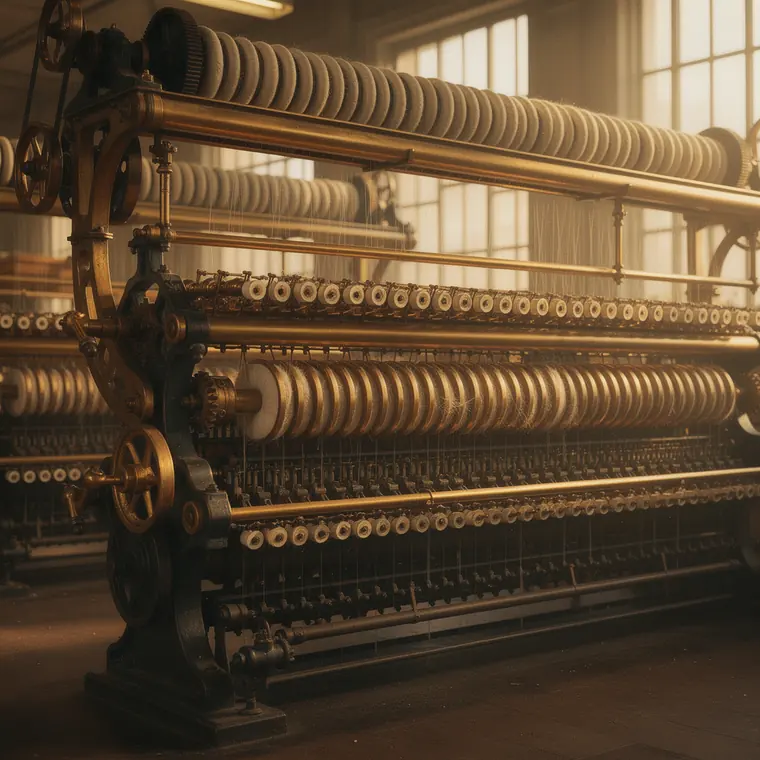
John Thorp's ring spinning frame in a Rhode Island mill, travellers circling the rings on the lifting rail while bobbins spin, a creel of roving bobbins ranged above.
- What it was used for
- Continuous spinning of cotton yarn, in the United States used almost entirely for warp from the start. US patent X5,322, granted 31 December 1828 to John Thorp of Providence, Rhode Island. The specification itself burned in the Patent Office fire of December 1836; what survives is the drawing and the printed description in the Journal of the Franklin Institute of July 1829. In America the ring displaced the mule slowly: on the census figures compiled by Copeland in 1912 there were 3.7 million ring against 3.4 million mule spindles in 1870, but 17.9 against 5.2 million in 1905. In England the ratio ran the other way: in 1909 the masters' federation counted 39.8 million mule and 7.9 million ring spindles there.
- What was new
- The machine spun continuously without a flyer. In its place sat a ring lying loose in a groove, free to yield to the pull of the yarn; the friction it meets there produces the winding tension. This matters for the question of attribution: the description printed in 1829 contains no traveller at all, the yarn revolves on the surface of the ring. The C-shaped steel wire traveller that made ring spinning practicable is not in it; according to the Rhode Island preservation commission Thorp's second patent of 1844 names a revolving hook, and Nathan Place Hicks made travellers of uniform quality from 1854. Who was first is not settled in the trade literature: the patent register names Thorp and 31 December 1828, Evan Leigh in 1875 credited a Mr Jencks of Pawtucket, and Copeland in 1912 names a Mr Jenks about 1830 in one place and gives 1831 without a name in another.
Further reading
- DATAMP, US-Patent X5,322 - Spinning Machine, Called Ring Groove Spinner (mit Abdruck Journal of the Franklin Institute, Juli 1829)
- Melvin T. Copeland, The Cotton Manufacturing Industry of the United States, Harvard 1912, S. 66-71
- Evan Leigh, The Science of Modern Cotton Spinning, 3. Aufl., Bd. II, Manchester 1875, S. 223-227
- Rhode Island Historical Preservation Commission, Jenckes Spinning Company Historic District, Pawtucket (Archivfassung)