Heilmann Comber
1845 · Cotton Combing Machine · Work 294 of 1,871
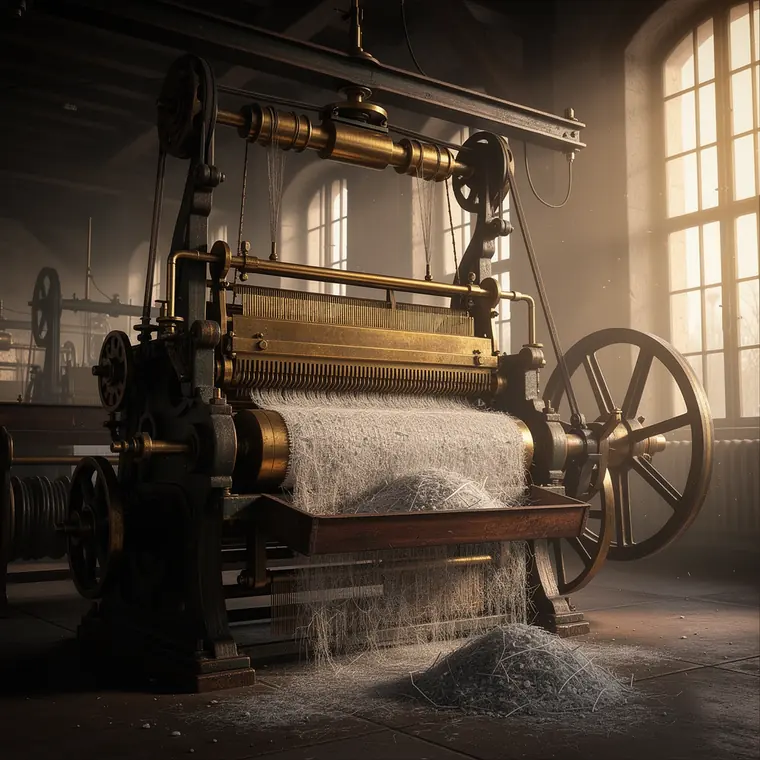
Josue Heilmann's cotton combing machine in an Alsatian mill, the half-lap cylinder gripping a fringe of fibre while the top comb clears short ends into a waste tray.
- What it was used for
- Combing cotton for fine counts. The machine took shape in the workshops of Nicolas Schlumberger & Cie at Guebwiller; the maker dates the patent application to 1843 and the first machine built to 1846. It appeared in England at the 1851 exhibition; shortly afterwards a Patent Combing Company in Manchester bought the cotton patent for 30,000 pounds and John Hetherington and Sons became the sole builder. At first it was thought applicable only to counts finer than 200, then to 120, later also to sewing thread of 50 to 80. On the maker's own account, already printed in Leigh's edition of 1873, more than 1,600 machines were at work, each producing 120 to 200 lbs of combed cotton a week.
- What was new
- It did not merely take out neps and dirt, as the card does, but drew the shortest fibres out of the sliver. The trick: the fibre is first held at the rear while its forward end is combed, then a second comb moves into its path and the rear end is drawn through it, each fibre being thus combed at both ends. Because carding had to come before combing, it never replaced the card, only the finisher card for fine yarns. Thornley wrote in 1902 that innumerable attempts had been made to supersede it, but that it was questionable whether a single cotton comber was working in England except single and duplex Heilmann combers, and that in its essential features the machine had been very little altered since its introduction. The date 1845 does not appear in the French sources; the maker gives 1843 for the application and 1846 for the first machine, the Société Industrielle de Mulhouse 1843 for the machine itself.
Further reading
- Evan Leigh, The Science of Modern Cotton Spinning, 3. Aufl., Bd. II, Manchester 1875, S. 161-167 (Bericht von John Hetherington and Sons)
- T. Thornley, Cotton Combing Machines, London 1902, Vorwort und S. 33-34
- N. Schlumberger (NSC), Guebwiller, Firmenhistorie
- Société Industrielle de Mulhouse, Fondateurs - Josué Heilmann