Noble Comb
1853 · Wool Combing Machine · Work 295 of 1,871
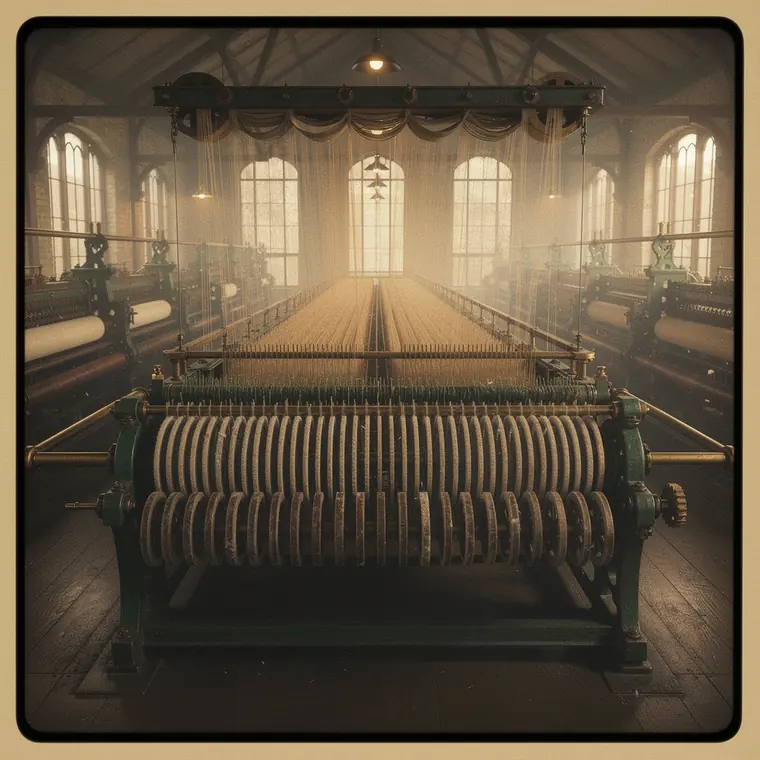
James Noble's wool comb in a Bradford worsted mill, one large horizontal circle of upright pins carrying two smaller inner circles, drawing-off rollers taking sliver away.
- What it was used for
- Combing wool for the worsted trade: two revolving comb rings, the smaller inside the larger, nearly touching at one point, where the fibre is laid across and combed at both ends. In his patent appendix of 1889 Burnley lists patent No. 894 of 13 April 1853 to James Noble - Noble filed two different machines that day. Burnley states plainly that Noble's principle became of real importance only after the feed apparatus introduced in 1856 by Tavernier, Donisthorpe and Crofts and through its construction by Taylor, Wordsworth and Co. of Leeds. By 1889, in his judgement, it was the machine most widely adopted in England apart from the works of Isaac Holden and Sons. According to the Calderdale Industrial Museum the Noble comb stayed in use in the worsted industry until 1989.
- What was new
- The pair of rings was not new. Burnley: the Collier machine was the first to comb by two revolving comb rings, but it did not have the filling-in performed at the point of contact, doing it at any point of the circumference at pleasure. What was new was laying the fibre in exactly there, and the choice of internally tangent rings, which gives a longer line of contact. The machine worked continuously instead of in the intermittent beat of the rectilinear combs, and delivered two slivers at once. Burnley traces its perfection through radial segment combs back to Heilmann's mechanisms. Who owns the invention is open: Burnley speaks of a slight mystery about its origin and holds there is little doubt the merit of the practical application belongs to Donisthorpe - his ground being what was generally understood and a letter in the Bradford Observer of 18 February 1875, not a record.
Further reading
- James Burnley, The History of Wool and Woolcombing, London 1889 (Noble-Kapitel und Patentanhang)
- Australian Wool Education Trust, WOOL 482/582 Wool Processing, Topic 11: Wool Combing
- The Yorkshire Post: Noble Comb - How Yorkshire businesses came together to rebuild a piece of our industrial heritage (Calderdale Industrial Museum)