Horrocks Loom
1803 · Part Metal Loom · Work 297 of 1,871
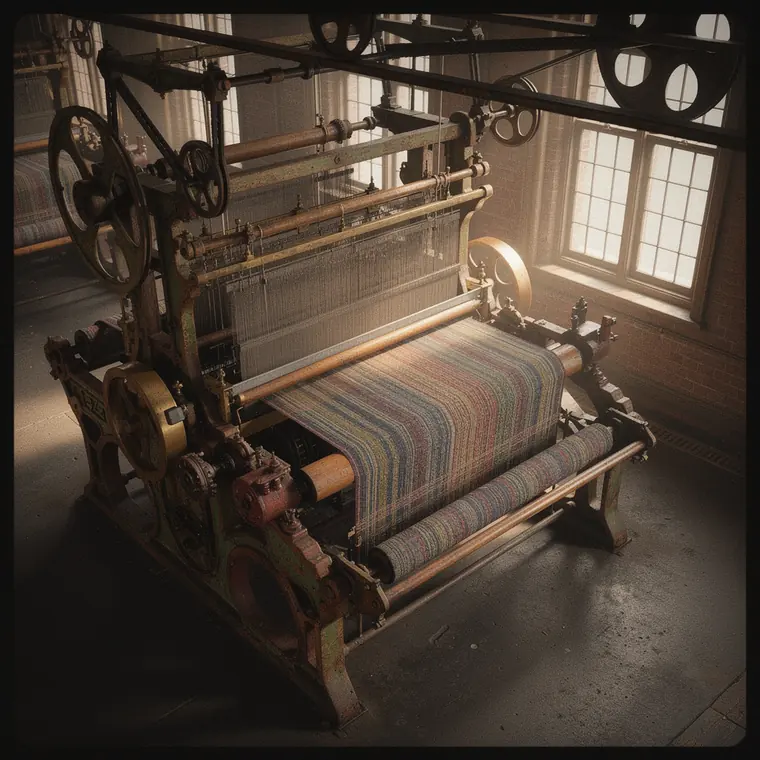
William Horrocks' power loom in a Stockport weaving shed, the variable speed batten motion driven by cams, warp beam and cloth roller held in a squat low frame.
- What it was used for
- William Horrocks was a cotton manufacturer in Stockport. His patent No. 2699 of 20 April 1803 covers improvements to a loom for weaving cotton and other goods by steam and water. Baines judged in 1835 that Horrocks's loom was the one that had now come into general use, constructed entirely of iron and taking so little space that several hundreds might be worked in a single room of a large factory. In the same breath he qualifies it: there were scarcely two establishments in which looms were fitted up alike in all their parts. The plates in his book come from drawings by the machine-makers Sharp, Roberts and Co. of Manchester. In 1813, the year of Horrocks's third patent, there were on Baines's figure still only 2,400 power looms in Britain.
- What was new
- The official abridgment states expressly what the patentee claims in 1803: the picking motion, made of cams on the cam shaft acting through levers and rods on the picker stick. The taking-up motion usually credited to this loom appears only in patent No. 2848 of 14 May 1805 - and on Radcliffe's statement, reported by Baines, it was copied from Radcliffe's hand-loom and was the invention of Thomas Johnson. Patent No. 3728 of 31 July 1813 then describes the variable lay motion: the lay is to remain nearly motionless while the shuttle passes between the warp, then advance quickly and give a sharp blow on the cloth. Cartwright had already described that effect in patent No. 1676 of 1788. Peter Marsland of Stockport had already patented in 1806 a lay that moves slowest while the shuttle passes through the warp.
Further reading
- Patent Office, Abridgments of Specifications relating to Weaving (Horrocks Nr. 2699, 2848, 3728; Taylor Nr. 3880; Cartwright Nr. 1676)
- Edward Baines, History of the Cotton Manufacture in Great Britain, London 1835 (Horrocks, Radcliffe/Johnson, Kraftwebstuhlzahlen)
- Richard Guest, A Compendious History of the Cotton-Manufacture, Manchester 1823