Waltham Power Loom
1814 · American Power Loom · Work 300 of 1,871
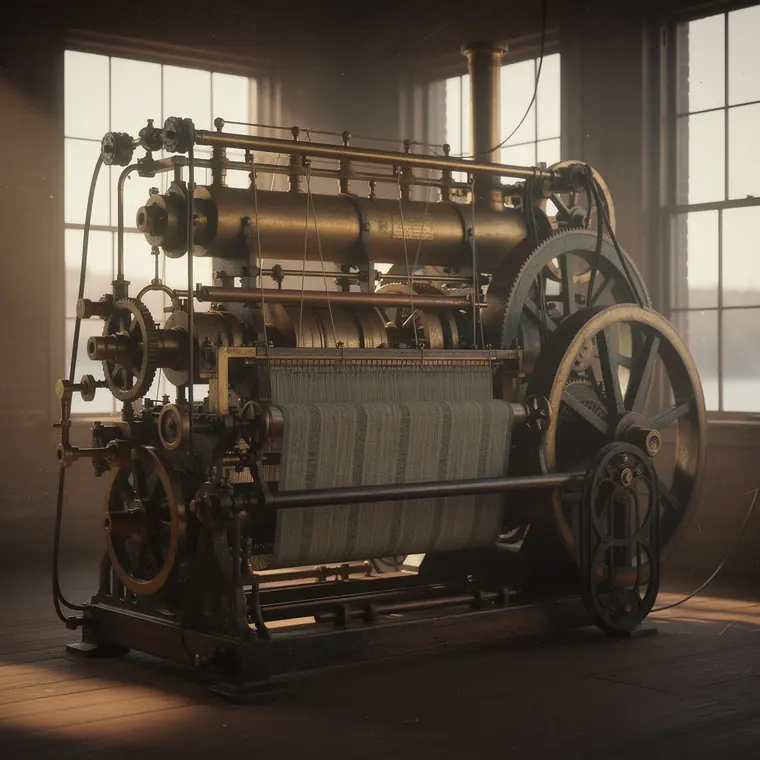
Francis Cabot Lowell's power loom in the Boston Manufacturing Company mill at Waltham, belts descending from ceiling shafting to rows of looms beside tall river-facing windows.
- What it was used for
- The Boston Manufacturing Company at Waltham on the Charles River. Francis Cabot Lowell had gathered what he could see in Britain between 1810 and 1812; Paul Moody of Amesbury built the loom. Nathan Appleton in 1858 dates the first run to the autumn of 1814; the Charles River Museum has the first factory operational by 1814. Appleton also gives the figure: the capital authorized by the charter was four hundred thousand dollars, but only one hundred thousand was to be raised until the experiment should be fairly tried; the full capital was later filled up and expended. Hours were twelve in winter and often fourteen in spring and summer, over seventy in the week. In the later Lowell mills the women stayed, on the National Park Service's account, about three years on average.
- What was new
- The loom was not the new thing - Lowell had memorised what he saw in Lancashire, and Moody built from that. What was new was the combination. Appleton wrote in 1858 of his late partner that he was unquestionably entitled to the credit of being the first person who arranged all the processes for the conversion of cotton into cloth within the walls of the same building - a partner's verdict on his own founder. The National Park Service says the same plainly: the power loom and related machinery permitted the combination of all the steps in the production of cloth under a single roof. Two further novelties were not machines at all: the joint stock company with transferable shares, not dissolved by a change of partner, and the recruitment of young single women from the countryside into company boarding houses.
Connections
Every connection names its kind. “Forerunner” on its own would be a claim.
- Follows fromCartwright Power Loom1785From 1810 Lowell spent two years touring British factories, above all in Lancashire, and memorized the construction and workings of the various power looms he observed. Many English mills then used Cartwright's loom, modified with improvements by Horrocks and others. From Lowell's model and rough drawings Paul Moody built a working power loom for Waltham after a year.Source: Charles River Museum of Industry & Innovation: Francis Cabot Lowell and the Boston Manufacturing Company, Teil 2 · William Arthur Atkins, Power Loom Invented, in: St. James Encyclopedia of Labor History Worldwide (Encyclopedia.com)
Further reading
- Nathan Appleton, Introduction of the Power Loom, and Origin of Lowell (1858), Volltext bei FRASER, Federal Reserve Bank of St. Louis
- National Park Service, Lowell: The Waltham-Lowell System
- Charles River Museum of Industry & Innovation, Francis Cabot Lowell and the Boston Manufacturing Company (Arbeitszeiten, Produktionsbeginn Anfang 1815)
- National Park Service, Lowell Handbook: Mill Girls (durchschnittlich rund drei Jahre)
- Charles River Museum of Industry & Innovation: Francis Cabot Lowell and the Boston Manufacturing Company, Teil 4