Cartwright Power Loom
1785 · Power Loom · Work 296 of 1,871
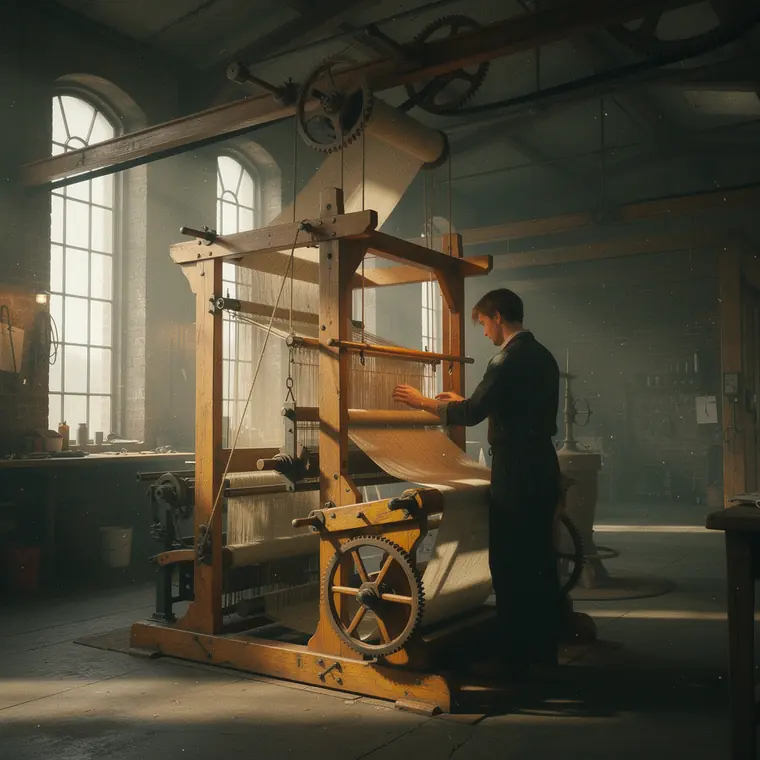
Edmund Cartwright's power loom in a Doncaster workshop, an upright wooden frame with the batten swinging from above and a rope drum turning the crankshaft below.
- What it was used for
- By his own account Cartwright's first specimen was woven on a warp of the material sail-cloth is usually made of. At Doncaster, where he moved in 1785, he set up a weaving works; the Science Museum records twenty looms at first, driven by a bull that was replaced by a steam engine in 1788-9. About 1790 the Grimshaws of Gorton erected a weaving factory under licence at Knott Mills, Manchester; in 1791 a Manchester firm contracted for 400 of his looms, of which, the DNB says, only some were worked by steam. In 1793 he gave up the Doncaster works, having spent some 30,000 pounds. On 7 June 1809 the Committee of the House of Commons resolved a grant of not more than 10,000 pounds, to be paid without any fee or other deduction whatsoever - moved after a memorial signed by about thirty manufacturers.
- What was new
- Patent No. 1470 of 4 April 1785 describes three things together: the warp placed vertically instead of horizontally, the shuttle thrown not by hand but by a spring, a pendulum, a hammer blow or some mechanical force, and lastly that the web winds up gradually as it is woven. There were forerunners: Baines names a weaving works of Mr Gartside in Manchester in 1765, probably filled with Vaucanson's looms, where no advantage was realized because a man was required to superintend each loom. The DNB quotes Barlow's history of weaving: Cartwright's was not the earliest power-loom, but it was the first by which wide cloth, such as calico, was woven for practical purposes. The working functions came only with the later patents: No. 1565 of 1786 describes stopping the loom on a broken warp thread and on a broken weft, No. 1616 of 1787 stopping it when the shuttle misses its box.
Connections
Every connection names its kind. “Forerunner” on its own would be a claim.
- Follows fromWater Frame1769Cartwright's own letter to Bannatyne, printed by Baines: at Matlock in the summer of 1784 the talk turned on Arkwright's spinning machinery; one of the company observed that once the patent expired so much cotton would be spun that hands could never be found to weave it. When the conversation later came back to his mind, he conceived the loom; patent of 4 April 1785.Source: Edward Baines, History of the Cotton Manufacture in Great Britain, London 1835, S. 229-230 (Wortlaut des Briefes, aus der Encyclopaedia Britannica)
- Works withKay Drop Box1760Barlow 1878: the drop box proved so useful that on the introduction of the power loom its application to that loom was at once suggested; Cartwright was perhaps the first to attempt it, and it is mentioned in his patent of 1792. It seems not to have been carried out successfully until many years afterwards; as late as 1830 Duncan found no plan yet adopted.Source: Alfred Barlow, The History and Principles of Weaving by Hand and by Power, London 1878, S. 287 (Kapitel XXVII, Drop and Circular Boxes)
Further reading
- Historic Hansard, DR. CARTWRIGHT, HC Deb 7 June 1809, vol 14 cc922-3 (Wortlaut der Entschließung)
- Patent Office, Abridgments of Specifications relating to Weaving (Nr. 1470, 1565, 1616, 1676)
- Edward Baines, History of the Cotton Manufacture in Great Britain, London 1835 (Cartwrights Brief, Gartside 1765, Grimshaw, Knott Mills)
- Richard Guest, A Compendious History of the Cotton-Manufacture, Manchester 1823
- Science Museum Group, Personeneintrag Edmund Cartwright
- Dictionary of National Biography (1887): Cartwright, Edmund (Wikisource)