Water Frame
1769 · Water Frame · Work 287 of 1,871
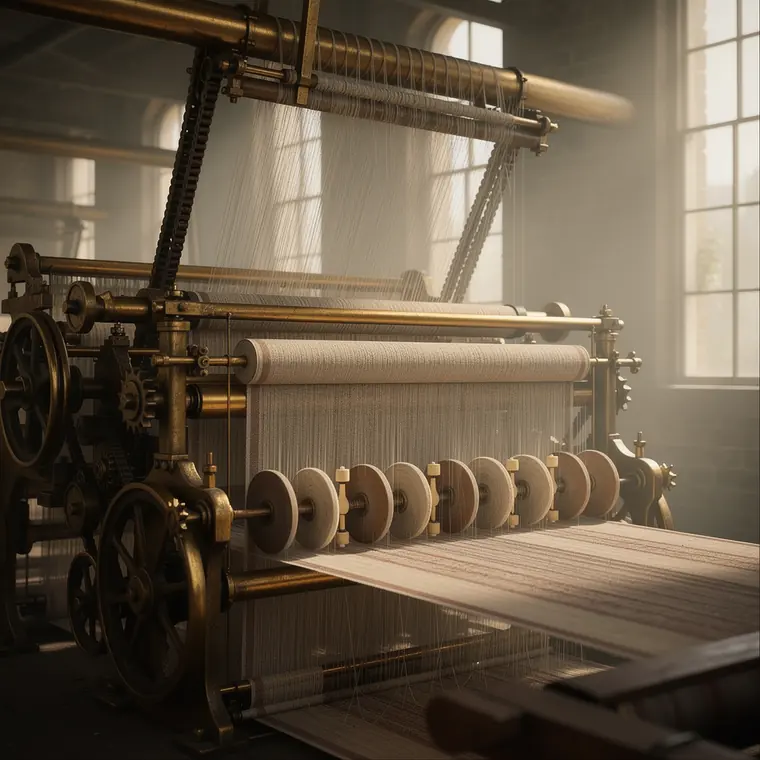
Arkwright's water frame standing in a mill room, four spinning positions with weighted roller pairs and flyer spindles, a driving belt running up to the shafting overhead.
- What it was used for
- Richard Arkwright and his partners - the bankers Wright, then Samuel Need of Nottingham and Jedediah Strutt of Derby - first put up a mill at Nottingham driven by horses; that proving too expensive, in 1771 they built the much larger mill at Cromford in Derbyshire, turned by a water wheel, from which the name comes. The machine span a hard, firm thread for warps, and so goods were for the first time in England woven wholly of cotton - which is why the firm petitioned Parliament about the calico duty in 1774. What it cost has figures: the Arkwright Society records paid work offered to seven-year-olds in 1771, thirteen-hour days, six days a week; in 1789, by the World Heritage Site's account, some 800 people were employed at Cromford and Masson, and by 1800 or 1802 the business as a whole had 1,150, of whom, by the Arkwright Society's count, 700 were classed as children.
- What was new
- Patent no. 931 was sealed on 3 July 1769 and the specification enrolled on 15 July 1769 - to "Richard Arkwright, of the town of Nottingham, clockmaker". Baines calls this "certainly an untrue description": Arkwright was a barber and wigmaker, and the clockmaker John Kay, from whom he is said to have taken the idea, was then in his service. What was new was not roller drawing - that had been patented thirty-one years earlier, no. 562 of 1738 - but its workable combination with flyer, bobbin and external power. Baines writes of two prior claimants and declares his strong conviction that Arkwright took the principle from Wyatt or Highs, while allowing him great inventive talent "in perfecting the details". Thomas Highs testified in 1785 that he had made two pairs of rollers in 1767, the second revolving five times as fast as the first; Baines answers that no witness but Kay speaks to it and no document attests it. It cannot be decided.
Connections
Every connection names its kind. “Forerunner” on its own would be a claim.
- Works withCromford Mill1771Baines: the first mill at Nottingham was driven by horses; that proving too expensive, in 1771 Arkwright and his partners built the much larger mill at Cromford in Derbyshire, turned by a water wheel - and from that circumstance the spinning machine was called the water frame.Source: Edward Baines, History of the Cotton Manufacture in Great Britain, London 1835, S. 153 und S. 186
Further reading
- Great Britain Patent Office (Woodcroft), Titles of Patents of Invention 1617-1852, Part I (Nr. 931, 3. Juli 1769, amtlicher Wortlaut)
- Edward Baines, History of the Cotton Manufacture in Great Britain, 1835 (Nottingham/Cromford, clockmaker, Highs und Kay, Spezifikation 15.7.1769)
- Cromford Mills (Arkwright Society): Our History
- Derwent Valley Mills World Heritage Site: Communities (Beschäftigtenzahlen 1789, 1802, 1816)
- Science Museum Group Collection: Arkwright's Water Frame, 1775