Cromford Mill
1771 · Water Powered Spinning Mill · Work 315 of 1,871
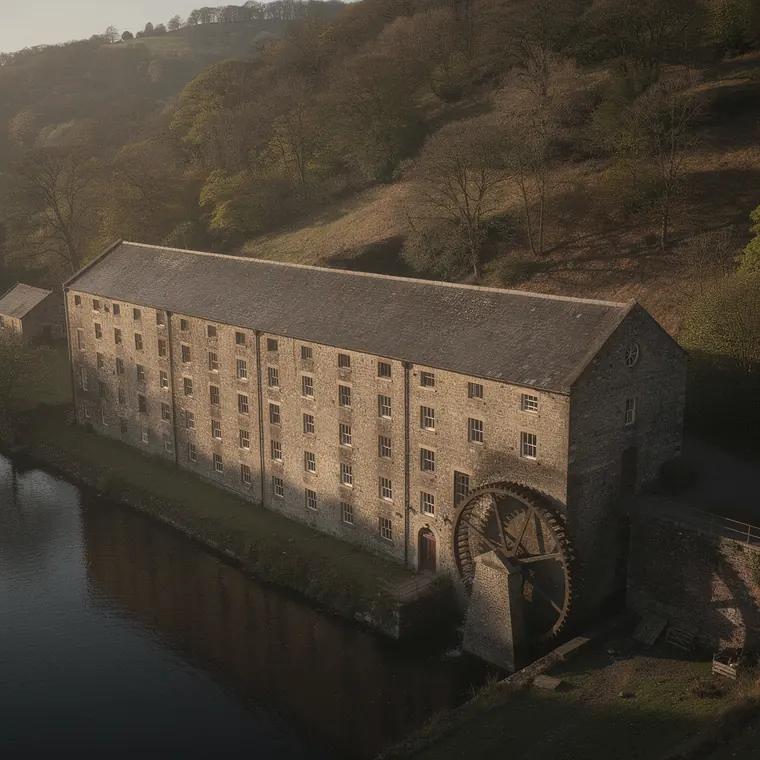
Arkwright's Cromford Mill in the Derwent valley seen from outside, a long narrow five storey stone block with plain walls and rows of small windows on every floor, a water wheel set against the end wall of the building and turning outside the wall, fed by a channel from the millpond sluice, daylight only, the wooded hillside of the valley behind.
- What it was used for
- Richard Arkwright built a water-powered spinning mill at Cromford in 1771 and a second, larger one in 1776-77. The Science and Industry Museum gives almost a thousand employed in Arkwright's mills as a whole by 1800 and, for their earliest days, working in two shifts of thirteen hours each. The Arkwright Society, which now looks after the site, counts 1,150 employed across three mills around 1800, among them 700 children, and still 725 in 1816, among them 269 children aged ten to eighteen. The village was part of the works: the sixteen houses of North Street nos 14-29, of 1776-77, have a workshop storey on the second floor; by the Landmark Trust's account the men worked there at loom or knitting frame, the women and children in the mill. Cotton production at Cromford ended around 1840 because the water supply was no longer sufficient.
- What was new
- Jenny yarn was too soft for the warp and served only as weft on a linen warp; the water frame produced yarn twisted hard enough for warp and weft both to be cotton. What was new was less the machine than what grew around it: a device too large and heavy for the house, a power source outside it, and from that a continuous operation that tied working hours, housing and family income to the works. The Derbyshire Historic Environment Record calls the Arkwright System a true blueprint for factory production. In law it did not hold: on 25 June 1785 a suit brought by the Attorney General to repeal the patent of 16 December 1775 was tried in Westminster Hall before Mr Justice Buller, and the court found against Arkwright. Formally it was a Crown writ of scire facias; in substance, by the Science and Industry Museum's account, Arkwright stood accused of copying the invention of Thomas Highs, who told the court the rollers were his.
Further reading
- Science and Industry Museum: Richard Arkwright, Father of the factory system
- Cromford Mills / Arkwright Society: Our History
- Historic England, Listeneintrag 1248131: The Arkwright Houses, North Street, Cromford
- Derbyshire Historic Environment Record MDR24287: Bridge at Cromford Mill (Listenbeschreibung)
- Wellcome Collection: The trial of a cause instituted by Richard Pepper Arden ... by writ of scire facias, to repeal a patent granted on the sixteenth of December 1775 to Mr Richard Arkwright, London 1785
- Landmark Trust: North Street, Cromford - History Album (PDF)