Roberts Cast Iron Loom
1822 · Cast Iron Loom · Work 301 of 1,871
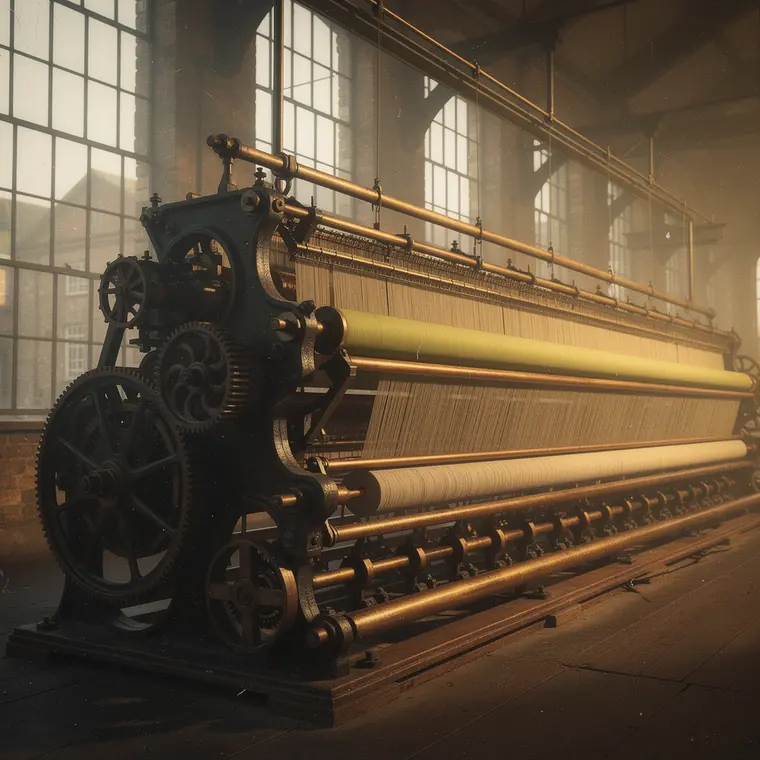
Richard Roberts' cast iron power loom in a Manchester weaving shed, positive let-off gearing on the warp beam and a weft fork guarding the shuttle race ahead.
- What it was used for
- Power weaving of plain cotton goods. The British patent No. 4726 is dated 14 November 1822. In 1835 Baines printed four views of the loom from drawings supplied to him by the machine-makers Sharp, Roberts and Co. of Manchester, describing it as the loom in its most improved state, as manufactured by them for plain work. The cast iron frame is not in the official abridgment of the patent but in the description of the machine given by Andrew Ure and quoted by Marsden in 1895: the framework is of cast-iron, composed of two sides, each cast in a single piece. Ure saw Roberts looms running at very various speeds, from 100 to 180 picks a minute, the average in the better loom shops being 120.
- What was new
- The patent describes six improvements. The chief ones: a tappet wheel with a set of levers, half of them elevating and half depressing, so that more than two shafts are positively controlled; a perforated roller covered with paper as a pattern carrier; a taking-up motion through a ratchet wheel and a click on a lever worked by the lay, of which Marsden wrote in 1895 that it is substantially the taking-up gear of to-day; and a positive let-off through worm and worm wheel. Marsden puts it that Roberts took the power loom as left by William Horrocks.
Connections
Every connection names its kind. “Forerunner” on its own would be a claim.
- Follows fromHorrocks Loom1803Marsden 1895, p. 73: "Richard Roberts took the power-loom as left by William Horrocks, and upon that built his modifications and improvements." Horrocks's improvements of 1803 had, on Marsden's account (p. 70), brought the power loom appreciably nearer commercial success while still leaving much to accomplish; that is where Roberts began.Source: Richard Marsden, Cotton Weaving: Its Development, Principles, and Practice, London 1895, S. 70 und 73
Further reading
- Patent Office, Abridgments of Specifications relating to Weaving (Roberts Nr. 4726, 14.11.1822)
- Richard Marsden, Cotton Weaving: Its Development, Principles, and Practice, London 1895, S. 72-85
- Edward Baines, History of the Cotton Manufacture in Great Britain, London 1835 (Tafeln nach Zeichnungen von Sharp, Roberts and Co.)