Northrop Loom
1894 · Automatic Shuttle Change · Work 304 of 1,871
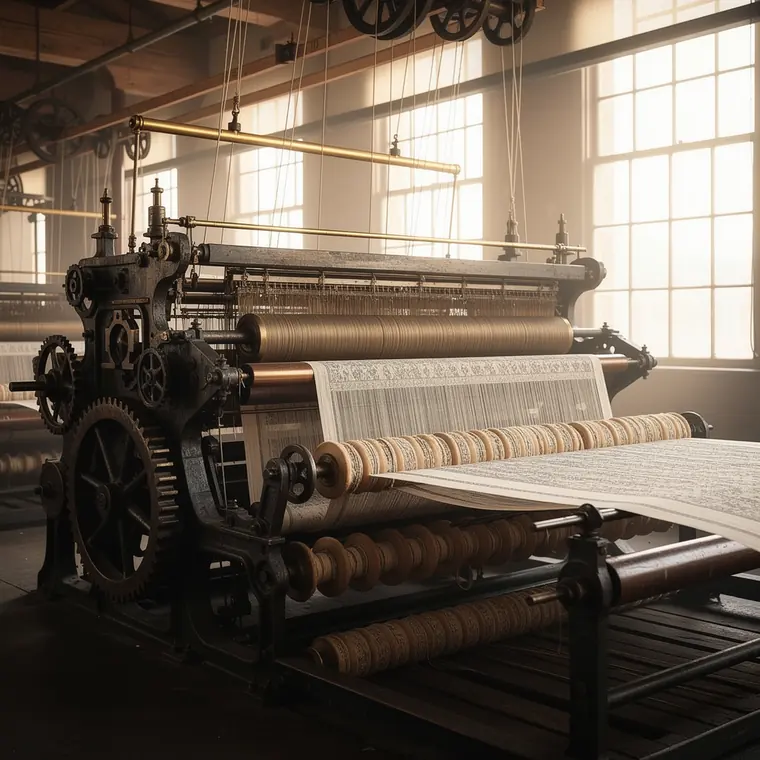
The Northrop automatic loom in a Hopedale weaving room, a rotary magazine of full bobbins swinging one into the shuttle without stopping the cloth running forward.
- What it was used for
- The Draper Company of Hopedale, Massachusetts, began taking orders in June 1894; the first complete Northrop looms ran in customers' mills at the beginning of 1895. Queen City Cotton Mill at Burlington, Vermont, started on 30 January 1895 with 792 looms and appears in Draper's 1907 customer list with 1,370 Northrop looms. On the same company publication, 139,085 complete Northrop looms had been sold to date in 1907, not counting licensed manufacture abroad. Draper's own figures for looms per weaver: four in England at 220 picks a minute, six to ten in the United States on plain goods, and with the Northrop easily twenty-four. Development cost the firm about 300,000 dollars, according to William F. Draper.
- What was new
- Automatic looms had been attempted before; by Draper's own investigation all actual attempts had been complete failures - a partisan account written amid patent litigation. What was new was that the loom does not stop for the change and the shuttle is not changed: a weft fork detects the absence of the thread, the forward motion of the lay tips a transferrer which presses the lowest bobbin from the magazine into the running shuttle and ejects the empty one at the same moment; the thread end is drawn into the self-threading shuttle eye at the next pick. US patent 454,810, filed 6 February 1891 and granted 23 June 1891, claims this. Northrop had first worked on changing the whole shuttle; parts for changing the filling in the shuttle were taking shape as early as October 1889. A mechanical warp stop motion was added, which Draper's inventors had to design afresh because no practical device existed.
Further reading
- Draper Company, Labor-Saving Looms, Ausgabe 1907, Hopedale, Mass. (Entwicklungsgeschichte S. 33-41, Stühle je Weber S. 31, Kundenliste S. 204, Verkaufszahl 139.085 S. 311)
- William F. Draper, Recollections of a Varied Career, Boston 1908, S. 201 und 252-253 (rund 300.000 Dollar Entwicklungskosten; Manchester 1895)
- US-Patent 454.810, James H. Northrop, Loom, angemeldet 6.2.1891, erteilt 23.6.1891
- Timothy Leunig, New Answers to Old Questions, LSE Working Paper 60/00 (1,25 Prozent der Lancashire-Webstühle 1914 automatisch, nach Sandberg)
- Burlington Free Press, 31.1.1895, zitiert in Kyle Obenauer: Queen City Cotton Mill, University of Vermont, Historic Preservation 2013