Brunel Circular Knitter
1816 · Circular Knitting Machine · Work 307 of 1,871
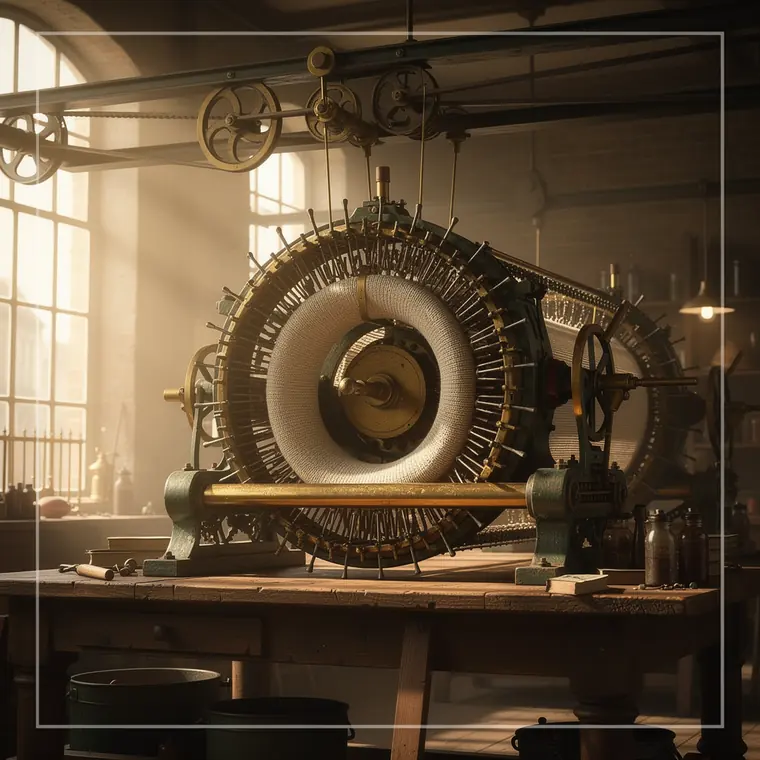
Marc Brunel's circular knitting machine on a workbench, a ring of hooked needles set around a small drum producing a seamless tube of stockinet in a London workshop.
- What it was used for
- Marc Isambard Brunel patented a circular knitting machine in 1816; the Science Museum catalogues it as a circular loop wheel knitting machine for hosiery. The surviving example reached the museum through the Leicester hosiery firm N. Corah and Sons. Which works ever ran it, what it produced and what it cost are not documented in the sources checked. The Victoria County History of Leicestershire records the opposite of commercial success: Brunel's machine was never put into general use, because it produced an unfashioned tube of fabric which had to be cut up, sewn and then steamed into shape, and there was considerable prejudice against that practice, especially among the knitters themselves. The hand frame stayed: William Felkin estimated 18,494 stocking frames in Leicester in 1844.
- What was new
- The stocking frame worked flat and shaped the garment while knitting, by narrowing and widening the courses; Brunel's machine, called the tricoteur in the trade literature, knitted a continuous circular tube whose shape had to be cut into it afterwards. The same source that records its failure calls the tricoteur the forerunner of the machine type on which the bulk of hosiery is now made. The latch needle came only in 1847 and was not Brunel's. No patent number for 1816 could be established and the specification could not be consulted; the sources say only that it was patented in 1816.